
"Evie podría estar ya perdida en las sombras."
That line hit me somewhere around hour sixteen, sitting cross-legged on my apartment floor in Capitol Hill, hearing aids cranked, captions scrolling on my tablet while Sandra Soria's voice dropped into something barely above a whisper. I had to rewind twice - not because I couldn't hear it, but because I needed to feel that shift again. The way Soria pulls back right before the emotional devastation? As a hard-of-hearing listener, this hit different. That restraint is what separates someone who performs from someone who just reads.
Sandra Soria Does What Most Narrators Won't
Let me be blunt: Soria carries this book. Almost twenty hours of Spanish-language narration and she doesn't flag. Her Luc voice has this controlled edge - part threat, part desperation - that makes you understand why Evie keeps gravitating toward someone who is, let's be honest, terrifyingly possessive. She doesn't give Luc a cartoonish "dark and brooding" tone. Instead there's this subtle tension in her delivery, like she's holding something back in every sentence he speaks. That's a choice, and it's the right one.
Her Evie is harder to pin down, and I think that's partly the material's fault. Evie spends a lot of this book reacting rather than driving the story, and Soria can only do so much with passages that circle the same emotional ground for chapters at a stretch. But when the text gives her room - especially in the final two hours when everything collapses - she absolutely goes for it. The ending sequences have this raw, cracked quality in her voice that my hearing aids picked up in a way that felt almost physical. Clarity over speed - always. And Soria gets that instinctively.
Caption sync was perfect throughout, which matters enormously for a book this long. I was syncing the Spanish text on my Kindle while listening, and the pacing matched cleanly. That's not nothing - I've had Spanish-language audiobooks where the narrator's rhythm drifts from the text by mid-book and it becomes impossible to follow both streams.
Twenty Hours Is a Lot of Orbit Without Much Trajectory
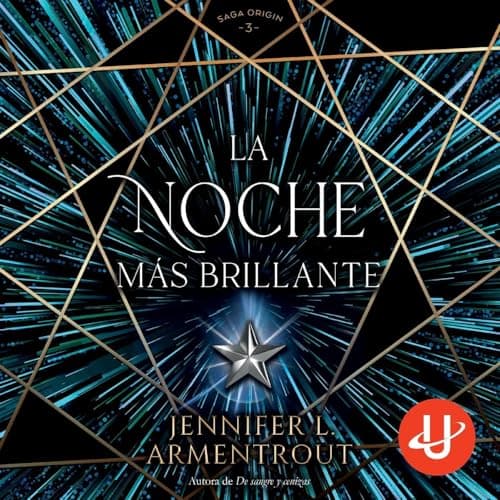
Here's where I have to be honest, and this is where it stings because I genuinely love Armentrout's Lux universe. La noche más brillante is book three in the Origin series, and it feels like a book that needed to be thirteen hours, not almost twenty. There are long stretches - particularly in the middle third - where Evie and Luc circle each other emotionally without the plot actually moving. The "peligrosas habilidades" Evie is supposedly struggling to control? We hear about them constantly but the actual consequences feel deferred, deferred, deferred until the final act.
The romance is heavy. Like, really heavy. If you're here for the alien-invasion sci-fi elements and the Zone 3 worldbuilding, you'll spend significant time wading through relationship processing that doesn't always earn its page count. Los siete maridos de Evelyn Hugo does something similar — buries you in emotional processing — but earns every page of it because the relationship architecture keeps shifting under you. Evie's internal monologue repeats certain anxieties - about Luc, about her identity, about control - in ways that started testing my patience by hour ten. And look, I'm someone who listens to twenty-hour books regularly for work. I'm calibrated for slow burns. This one needed a harder editorial hand.
When the plot does move, though? It moves. The revelations about Evie's past and what Luc has actually done hit like a gut punch. And that ending - the one that listeners keep calling heartbreaking - earned every bit of that reputation. Soria's performance in those final scenes is the emotional payoff for all that orbiting. I could feel the architecture of that climax through the text alone, but Soria's delivery elevated it into something genuinely devastating.
Missed Opportunity for Tone Shift in the Middle Act
One thing that bugged me from an accessibility standpoint: the tonal range in the middle section is too flat. When you have a protagonist with evolving, dangerous abilities in a secret community under threat, there should be escalating tension in the narration even during quiet scenes. Soria keeps things fairly steady through hours six through fourteen, and while that's partly a pacing issue in the writing, a narrator with this much skill could have pushed harder to differentiate the emotional temperature between scenes. A sharper tonal gradient there would've helped listeners (especially those of us processing audio differently) track the rising stakes without relying entirely on plot cues.
Who Should Listen (And Who Should Skip)
If you're already invested in the Origin series and you loved La sombra más ardiente, this delivers the emotional payoff you're waiting for - you just have to be patient getting there. If you're coming in cold, don't. This is a book three that assumes you know these characters, this world, these stakes.
Skip it - or at least brace yourself - if you need plot momentum to stay engaged during long listens, or if you mostly listen while multitasking. That middle section will lose you. I say that as someone who was doing focused, dedicated listening with text support and still felt the drag.
The Performance Saves What the Pacing Almost Doesn't
Soria's narration is the reason to listen rather than read. The performance is layered enough to feel, even through the slower passages. But I can't pretend the book itself is as tight as its predecessor. Armentrout's emotional instincts are sharp - that ending proves it - but she needed someone to tell her the middle third could lose five hours without losing anything that matters. Accessibility done right on the production side. The story itself just needed to trust its audience more and get there faster.