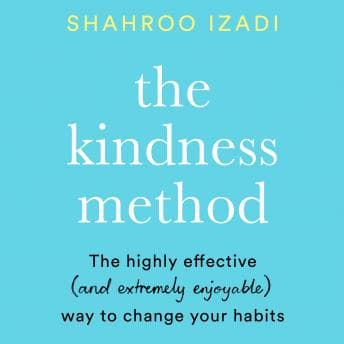

Everyone keeps telling me self-help books about habit change need to be tough-love, drill-sergeant energy. Atomic Habits gives you systems. Grit tells you to push harder. The Kindness Method says... maybe stop beating yourself up first? And honestly? After a week where I shipped a broken config to prod at 11PM and then stress-ate an entire bag of Trader Joe's dark chocolate almonds on the Caltrain home, I was maybe the exact right audience for that message.
I finished this in two commutes - it's under 5 hours, and at 1.75x (my standard speed for self-help that smells like it could've been a blog post), it moved fast. But here's the thing: this one actually earned most of its runtime.
The Anti-Optimization Optimization Book
So Shahroo Izadi is a behavioral change specialist who worked in addiction recovery, and she basically took the same compassion-based frameworks she used with substance dependence clients and repackaged them for, well, the rest of us who can't stop doomscrolling or skipping the gym or whatever your particular flavor of self-sabotage is. The core thesis is that shame-based motivation is a terrible long-term strategy - it's basically technical debt for your psyche. You white-knuckle through a change, it works for a bit, then you crash harder than before.
What makes this different from the "just be nice to yourself" Instagram therapy crowd is that Izadi actually gives you frameworks. There's a mapping exercise where you document your triggers, your emotional state before a habit kicks in, and - this is the part that stuck with me - what you're actually getting OUT of the bad habit. Not in a judgmental way. Like, genuinely: what need is this meeting? She talks about her own experience losing over eight stone (that's 112 pounds for us Americans) after years of yo-yo dieting, and she's refreshingly specific about how the shame cycle kept pulling her back. She didn't just "decide to change" - she had to understand why the old patterns were serving her before she could build something better.
This is basically debugging your habits with empathy instead of a stack trace.
Author-Narrated: The Double-Edged Sword That Actually Works Here
I'm usually skeptical of author-narrated self-help. Half the time you get someone reading their own book like they're presenting quarterly results to a bored board. Izadi is... not that. Her delivery is warm without being saccharine, and when she shifts into the personal anecdotes about her weight loss journey versus the more clinical behavioral frameworks, you can hear the genuine shift in energy. She sounds like a therapist who actually likes her clients. (I've had therapists who don't, trust me, you can tell.)
The downside of audio for this specific book: there are exercises. Mapping exercises, journaling prompts, self-assessment stuff. And listening to someone describe a worksheet you should be filling out while you're sardined between a guy manspreading and someone's enormous backpack on the 6:47 Caltrain is... not ideal. You're not going to pull out a notebook. You're barely conscious. I'd say the conceptual chapters work great on audio, but if you're serious about doing the actual work, you probably want the physical book too.
Where It Loses a Star (And Where It Earns Its Keep)
My gripe: it can feel repetitive. The core concept - be kind to yourself, understand your triggers, build sustainable change - gets restated in slightly different flavors across chapters. If you're coming from Atomic Habits or BJ Fogg's Tiny Habits, the tactical framework here is thinner. Izadi isn't giving you a system architecture; she's giving you a mindset shift. And if you already GET the mindset, some sections feel like padding.
But here's who this book is actually for: the person who's read all the optimization books, knows exactly what they "should" do, has the perfect Notion template for habit tracking, and still can't stick with anything because underneath all that productivity scaffolding, they fundamentally believe they don't deserve good things. (I didn't come here to be personally attacked either, but here we are.)
The ROI on this audiobook is high if you're in that specific headspace. If you're looking for a new system or framework, look elsewhere. If you need someone to calmly explain why your last twelve attempts at change failed despite having "all the right tools" - this is your book.
Perfect For: Recovery Weeks, Not Sprint Planning
Perfect for: commute, light housework, walks. Skip for: gym (too reflective), deep work (not dense enough).
If you loved Atomic Habits for the systems but felt like it was missing the "why do I keep sabotaging myself" layer, this fills that gap. If Kevin ever asks why I'm being suspiciously nice to myself about my screen time habits instead of white-knuckling another digital detox, I'm blaming Shahroo Izadi.
Short, digestible, genuinely useful if you catch it at the right moment in your life. Not every book needs to be a 20-hour epic. Sometimes you just need someone to tell you it's okay to start from where you are. The compassion-first framing here reminded me of Mother and Son: The Respect Effect, which takes a similarly warm, non-punitive angle on changing deeply ingrained relational patterns - different subject matter entirely, but the same underlying philosophy that understanding beats shame every time.