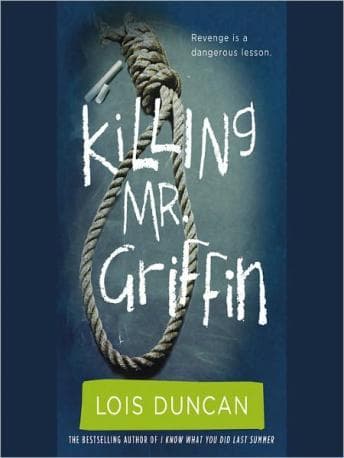

What happens when you give teenagers the power to punish the adults who've wronged them?
I was shelving returns at the library last Tuesday—one of those quiet evening shifts where the fluorescent lights buzz louder than any patron—when this question started gnawing at me. I'd been listening to Killing Mr. Griffin through my earbuds, and Lois Duncan's premise had wormed its way under my skin in that particular way only good YA horror can manage.
Here's the thing about this book: it understands that horror isn't about gore—it's about dread. The slow, sickening realization that a "harmless prank" has spiraled into something irreversible. Duncan wrote this in 1978, and the modernized text doesn't sand down the edges that made it controversial. Kids plot to kidnap their teacher. Things go wrong. Someone dies. And then—this is where Duncan really twists the knife—they have to live with it.
When the Monster Wears a Letterman Jacket
Mark Kinney is the real horror here, not Mr. Griffin. Duncan does something brilliant: she makes Mark charming. Likeable, even. You understand why Susan falls for him, why the other kids follow his lead. And that's terrifying, because you're watching a sociopath operate in real-time, manipulating everyone around him while maintaining plausible deniability.
The book earns its place in the YA horror canon because it refuses to let anyone off the hook. Substitution Order operates on that same principle—nobody gets to claim innocence when the system itself demands complicity. Susan isn't some innocent bystander—she makes choices. Bad ones. Ones she can't take back. Duncan respects her teenage characters enough to let them be genuinely culpable, and that's rarer than it should be.
Dennis Holland's Delivery (And Why It Doesn't Work)
Okay. So. Dennis Holland.
Look, I listened to this during that library shift, then continued on my drive home, and I'll be honest—I had to crank it to 1.25x speed by chapter three. Holland's delivery is... slow. Southern. Monotone. One reviewer mentioned almost falling asleep in traffic, and I get it. The pacing of his narration doesn't match the mounting tension of Duncan's prose.
This is a book about teenagers making increasingly desperate decisions under pressure. It should feel breathless. Panicked. Instead, Holland reads it like he's got all the time in the world. The character differentiation is minimal—I couldn't always tell which kid was speaking without context clues—and that's a problem when you're juggling multiple conspirators with different levels of guilt.
He's not bad, exactly. The narration is competent. Clean audio, no weird production issues. But competent isn't enough for a thriller that lives or dies on escalating dread. He doesn't commit the way this material demands. And that's frustrating, because the source material deserves better.
Who Should Press Play (And Who Should Run)
If you're a Duncan completist, or you want to revisit a formative YA thriller from your past, this audiobook will do the job. The story holds up. The moral complexity holds up. Duncan's understanding of teenage psychology and the seductive nature of groupthink? Still sharp. That same psychological precision—watching ordinary people justify terrible things—is what makes Femicide so unsettling.
But if you're coming to this fresh, wanting the full horror experience? I'd almost recommend reading the physical book instead. Or at minimum, bump that playback speed. At 1.25x, Holland's delivery approaches something like urgency. Skip this version if you need dynamic voice work to stay engaged—the monotone will lose you by chapter two.
This isn't a bedtime listen unless you want very strange dreams. It's not great for background listening either—you'll miss the psychological nuances that make it work. Best consumed during focused attention: a long commute, maybe, or a quiet evening when you can really sit with the discomfort.
(Shirley, my cat, was unimpressed when I tried to explain why I was stressed about fictional teenagers. She's never been a Duncan fan.)
Closing the Book on This One
Lois Duncan walked so every YA thriller writer could run, and Killing Mr. Griffin remains a clinic in consequence. It's not about whether they get caught—it's about watching them unravel, watching the lies compound, watching the guilt eat them alive or not at all.
The audiobook version, though? It's a wait-for-sale situation. Holland's narration doesn't ruin the experience, but it doesn't elevate it either. For a seven-and-a-half-hour listen, you want a narrator who understands that horror requires pacing, requires tension, requires commitment. This one just... reads.
My podcast listeners are going to love discussing this book. The audiobook? That's a harder sell.









