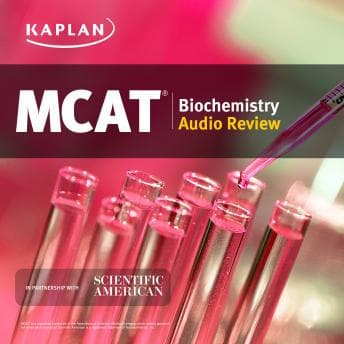

Kevin was out with friends last Saturday, and I had the apartment to myself, a half-finished cup of coffee, and zero desire to stare at another Confluence doc. So I did what any reasonable person does at 10 AM on a weekend: opened up a 26-hour biochemistry audio course I'd been stress-eyeing for two weeks.
Look, I'm not pre-med. I picked this up because a friend who's deep in MCAT prep kept texting me panicked questions about enzyme kinetics, and I figured - how different can it be from systems design, really? Turns out: pretty different. But also weirdly not?
TL;DR: Worth your commute. If you're actually studying for the MCAT, this is a legitimate study tool that earns its 26 hours. If you're just biochemistry-curious like me, it's still surprisingly listenable - but you'll want that downloadable workbook open, or you'll lose the thread fast.
Five Narrators, One Study Group (That Actually Works)
Here's what I didn't expect: the multi-narrator format is doing real architectural work here. Jeffrey Koetje hosts, and the other four - Amit Raghavan, Elizabeth Flagge, Kiran Thomas, Owen Farcy, Tamara Miller - rotate through chapters like a panel discussion. It's not a textbook being read at you. It's closer to sitting in on a very focused grad student study session where everyone actually did the reading. The last time a non-fiction audio production made me feel that genuinely included in a conversation was Bad Blood, where the narration pulls you so deep into Theranos's inner circle that you forget you're on a train.
The delivery is clear and structured without being robotic, which matters a lot at 1.5x (yes, even for biochemistry - I tried it). The conversational handoffs between panelists help your brain register topic shifts. When one voice takes over amino acid structures and another picks up on membrane transport, it functions like a chapter break your ears can detect without checking the timestamp. That's genuinely useful UX for audio learning.
No Ray Porter vibes here, obviously - this is functional narration, not performance narration. But functional is exactly what you need when you're trying to retain the difference between competitive and noncompetitive enzyme inhibition.
The Workbook Problem (And Why It Matters)
Okay, real talk: this is the most workbook-dependent audiobook I've ever encountered. The description says "follow along as you listen" and that's not marketing fluff - it's a warning. The 150-page downloadable workbook isn't supplementary. For complex topics like cell metabolism pathways or the specifics of the electron transport chain, audio alone is going to leave gaps. You can hear that something is being diagrammed even when there's no diagram.
This is basically Khan Academy but for your earbuds - with the same caveat that some concepts genuinely need a visual component to stick. The audio course handles conceptual explanations and mnemonics really well. The structural stuff - amino acid R-groups, metabolic pathway intermediates - those are harder to hold in working memory without the accompanying page.
I listened to the amino acid chapter twice. Once on a walk without the workbook, once at my desk with it open. Night and day. The second pass actually landed.
For commute listening specifically: chapters that are more conceptual (the opening framing of biochemistry, learning strategies, high-yield MCAT topic breakdowns) work great on the train. The dense mechanistic chapters - save those for when you can glance at the workbook.
Who This Is Actually For
If you're MCAT prepping: this is a legitimate supplement to your Kaplan book stack, not a replacement. The ROI on this audiobook is real - 26 hours of expert explanation you can absorb during commutes, gym sessions, or insomnia spirals. It fills in the "I read this but it didn't stick" gap that textbooks leave.
If you're a working professional who just wants to understand biochemistry better: doable, but you'll need patience. The MCAT framing is constant - everything is oriented around what's tested and how. That's actually useful context, but it means the course isn't trying to be broadly educational. It's trying to get you points on a specific exam.
Skip this if you're hoping for passive background listening. This is not a podcast. It demands active ears.
I finished about 14 of the 26 hours before I had to admit I was in over my head on glycolysis specifics and needed to actually pull up a diagram. No regrets on the first 14 hours though. The enzyme kinetics section alone would've saved me 40 minutes of confused texting.