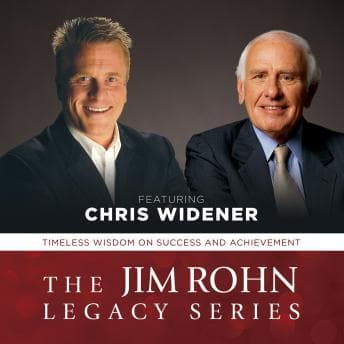

Self-help audiobooks and I have a complicated relationship. Professionally, I study how narratives shape identity - which means I spend a lot of time watching people absorb stories about who they could become and then asking: does this actually work? So when I sat down with The Jim Rohn Legacy Series during a long Sunday of cooking dal makhani (the kind that needs three hours of supervision and leaves you with nothing to do but think), I was already running my internal skepticism protocol.
Here's what surprised me: I didn't hate it.
That's not faint praise from someone who has read enough narrative psychology to be deeply suspicious of the motivational industrial complex. It's genuine.
What Widener Actually Gives You (And What He Doesn't)
The structure here is interesting and worth understanding before you click purchase. This isn't a Jim Rohn audiobook. It's Chris Widener talking about Jim Rohn - seven years of mentorship distilled into a few segments, plus Rohn's actual last recorded interview tacked on at the end. Psychologically, this is a fascinating case study in parasocial transmission: Widener absorbed a mentor's worldview so completely that he became a vessel for it. Whether that's admirable discipleship or something slightly more complicated is a question I found myself turning over while stirring the pot.
The content itself follows Rohn's well-documented framework: personal philosophy as the foundation of results, the discipline of daily habits, the idea that you become the average of the five people you spend the most time with (which the research actually shows has real empirical weight, even if Rohn arrived there through observation rather than controlled studies). Widener presents these not as abstract principles but as things he watched Rohn live - and that specificity is what keeps it from feeling like a Wikipedia summary of self-help tropes.
The last recorded interview segment is the genuinely irreplaceable piece. Rohn's voice - older, measured, with a kind of deliberate calm that Widener's narration can't quite replicate - carries a different texture. There's something about hearing a person articulate their own philosophy near the end of their life that no secondhand account can substitute for. I found myself asking: why does this section hit differently? And the answer is probably that authenticity functions as its own argument. You're not being told what Rohn believed. You're watching him believe it.
The Narrator Problem (Which Is Also a Structure Problem)
Widener narrates his own material, which makes sense. He's a speaker by trade and it shows - clean delivery, good pacing, no audio issues to complain about. The problem is more conceptual than technical. When Widener narrates Widener talking about Rohn, there's a slight hall-of-mirrors quality. The credibility rests entirely on trusting Widener's account of Rohn's account of success. That's two layers of interpretation before you get to anything you can verify.
For listeners who are already Rohn devotees, this probably feels like intimacy. For skeptics like me, it occasionally felt like reading a biography written by someone's most devoted student. Hagiography isn't automatically false, but it does require more critical processing on the listener's end. The mechanics of how belief gets transferred through persuasive framing is something I went deep on while reading Manipulation: The Ultimate Guide To Influence People with Persuasion, Mind Control and NLP - a book I'd rate considerably lower than this one, but which at least names the machinery explicitly rather than leaving you to reverse-engineer it yourself.
Also: 2 hours 44 minutes. This is a short commitment. Which means if you're on the fence, the math is pretty forgiving.
Who This Is Actually For
If you're new to Rohn's ideas, this is a reasonable entry point - compact, accessible, and the last interview gives you direct access to the source. If you've already read The Art of Exceptional Living or listened to Rohn's own recordings, Widener adds context but not necessarily new intellectual territory. If you're a psychology researcher who gets annoyed when self-help frameworks ignore variance in human behavior - well, you'll still find things worth chewing on, you'll just be doing more active processing than the format probably intends.
My therapist would have thoughts about the chapter on who you surround yourself with. Probably positive ones. She's been trying to make that point for two years.
Borrow it first. Then decide if you want to own it.