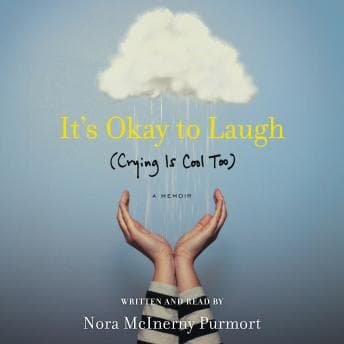

This book wrecked me at a faculty holiday party.
Let me back up. Denise and I were at Principal Martinez's annual December thing — the one where everybody pretends the store-bought cookies are homemade and we all avoid talking about standardized testing. I had my earbuds in during a lull (one earbud, I'm not a monster), and Nora McInerny Purmort was telling me about writing her husband Aaron's obituary while he was in hospice. The one where they gave him the secret identity of Spider-Man. And I was standing next to the punch bowl, laughing so hard that Mrs. Chen from the math department thought I was choking, and then thirty seconds later I had to excuse myself to the hallway because my eyes were doing something I'm going to call "aggressive moisture management."
That's this book. That's exactly what it does to you.
Grief Doesn't Wait for You to Finish Laughing
Here's what Nora McInerny understands that most memoir writers don't: grief and comedy aren't opposites waiting for their turns. They're roommates. They share a bathroom. She'll be mid-joke about the absurdity of wedding planning around chemo schedules, and then — without warning, without a tonal shift you can brace for — you're in the hospital room and Aaron is dying and she's holding him and you realize the joke was never separate from the pain. It was growing out of it the whole time.
This reminds me of what Hemingway said about writing — "all you do is sit down at a typewriter and bleed." Except Nora bleeds and then makes you snort-laugh at the Band-Aid she puts on it. The section about their summer together, the one where Aaron's health is clearly declining but they're squeezing every drop of joy out of ordinary Tuesday mornings and pancakes at weird hours — the prose deserves to be savored. She's not performing tragedy. She's just telling the truth about what it's like when the person you love most is leaving, and you still have to, you know, live.
Why Author-Narrated Is the Only Way to Hear This
I used to be skeptical of authors narrating their own work. Most writers aren't performers. They stumble over their own sentences, which is ironic and kind of sad. But Nora reading her own story? It's not a performance. It's a conversation. You can hear when she's about to cry. You can hear when she decides not to. There's this energy — not polished, not actorly — just alive. When she talks about Aaron, her voice does something that no hired narrator could replicate. It gets warmer. Softer in specific places. Not in a generic "emotional delivery" way, but in the way your voice changes when you're talking about someone you still love who isn't here anymore.
The narrator understands that pause is punctuation. She knows when to let a joke land and when to let silence carry what words can't. At six and a half hours, it's tight — no bloat, no self-indulgent tangents that overstay their welcome. She gets in, she tells you the truth, she gets out.
The Uncomfortable Part Nobody Mentions
Here's where I push back slightly on the consensus. The book's marketing leans heavily into the "funny memoir about grief" angle, and it is that. But there are stretches — the miscarriage, the depression after Aaron's death, the raw mechanics of becoming a single mother — where "funny" isn't the word. Those sections are just honest. Uncomfortably so. If you're picking this up expecting a comedy special with sad parts, recalibrate. It's a grief memoir that happens to be written by someone genuinely funny. The distinction matters. Beautiful Country: A Memoir operates in that same honest register — it's not the genre label that defines it, it's the weight of what the writer is actually willing to say.
My students would hate this. I love it. Not because it's inaccessible — it's actually one of the most readable memoirs I've encountered in years — but because they'd have to sit with the discomfort of feeling two contradictory things at once. (Come to think of it, that's basically the entire AP English curriculum.)
Who This Is For (and Who Should Maybe Wait)
If you loved Joan Didion's The Year of Magical Thinking but wished it had more jokes about Spider-Man obituaries — this is your book. If you're currently deep in your own grief, be careful. Not because it's exploitative or cheap, but because Nora is so good at making you feel accompanied that the book ending might hit harder than you expect. If you loved Let's Pretend This Never Happened, this is its spiritual successor, but with higher emotional stakes.
Content warning: death, loss, miscarriage, depression. Not handled lightly, but handled with grace.
The Note I'd Leave on My Desk
I finished this walking the lakefront on a Sunday morning, Denise a few steps ahead of me, and I pulled out my earbuds and just watched her walk for a minute. Didn't say anything. Just watched. That's what good books about love do — they make you look at the person next to you a little differently. Not with fear. With attention.
Nora McInerny wrote a love letter disguised as a grief memoir, or maybe a grief memoir disguised as a love letter. Either way, it's one of the most alive books I've listened to about death. Worth pausing the faculty meeting for. Worth pausing everything for.