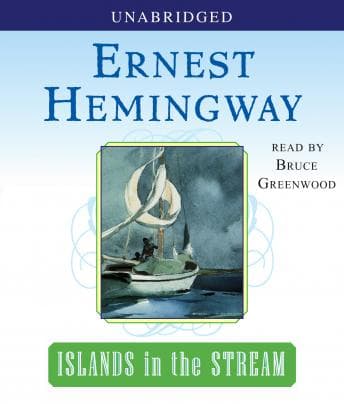

"Islands in the Stream" is the Hemingway novel that Hemingway didn't want you to hear. Not like this, anyway.
That's the thing about posthumous publications — you're listening to someone's unfinished business, the manuscript they were still wrestling with when the wrestling stopped. And you can feel that tension across every one of these fifteen hours. The brilliance is there, scattered across long Gulf Stream mornings and rum-soaked conversations, but so are the stretches where Papa was clearly still finding his way.
The Ghost of the Novel Hemingway Might Have Finished
I spent a whole Sunday with this one. Denise was visiting her sister, the apartment was quiet, and I had Thomas Hudson's Bimini for company. And for long stretches — particularly the fishing scenes, particularly the conversations between Hudson and his boys — I understood exactly why Hemingway kept returning to this manuscript. There's a looseness here you don't get in the published-in-his-lifetime work. Hudson watching his sons, trying to be present while knowing he's already failed at something fundamental about fatherhood. That hit different at fifty than it would have at twenty-five. That same raw, place-soaked honesty is all over Green Hills of Africa—Hemingway hunting more than just big game.
But here's what I tell my students about posthumous novels: they're not finished symphonies. They're rehearsal tapes. The Bimini section has the warmth and specificity of peak Hemingway. The Cuba section meanders. The At Sea section tightens into something urgent and sad. It's three different books wearing one dust jacket, and honestly, only one of them feels truly complete.
Bruce Greenwood Trusts the Pauses — Then Trips on "Conch"
Greenwood gets something right that a lot of Hemingway narrators miss — the silences. Hemingway's dialogue is famously about what people don't say, and Greenwood lets the weight sit there. When Hudson is talking to his ex-wife and every sentence is loaded with ten years of regret they're both too proud to name, Greenwood doesn't rush it. The narrator understands that pause is punctuation. That's rare and it matters.
But. And this is a real "but."
He pronounces "conch" as "konk." Throughout the book. In a novel set in the Caribbean. This is like narrating a novel about Chicago and calling it "Chi-KAG-oh" — once you hear it, you can't unhear it. It pulled me out of Bimini every single time, and in a book where Hemingway is working overtime to ground you in a specific place, that's not a small thing.
The ethnic accents are a mixed bag too. Some Spanish-inflected characters work fine. Eddie's accent wanders into territory that feels less like inhabiting a character and more like indicating one. There's a gringo-doing-Caribbean quality to some of the voice work that kept bumping me out of the dream. Greenwood's strongest when he's playing Hudson straight — those emotional core readings are genuinely beautiful, full of pathos and dry humor. When he reaches for the supporting cast, he doesn't always land.
Who Gets the Most Out of Fifteen Hours Here
This reminds me of what Hemingway said about writing — that the dignity of movement of an iceberg is due to only one-eighth of it being above water. "Islands in the Stream" shows you more of the iceberg than Hemingway probably intended. If you've read "The Old Man and the Sea" and "A Farewell to Arms" and you want to see the workshop, the drafts, the places where genius was still being shaped — this is invaluable.
If you're coming to Hemingway for the first time? Start literally anywhere else. "The Sun Also Rises." "For Whom the Bell Tolls." Come back to this one when you already love him enough to sit with his imperfections.
My students would hate this. The pacing alone would lose them by hour three. But that's partly the point — this is a book about a man sitting with his own loneliness, and Hemingway wasn't going to rush that for anyone.
The Assignment I'd Give Myself
Listen to the Bimini section. Just that first stretch. It's the closest thing here to a finished novel, and it's Hemingway writing about fathers and sons with a tenderness he rarely allowed himself in print. Greenwood earns his keep in those chapters despite the "konk" situation. The prose deserves to be savored. The rest is for completists and Hemingway scholars — which, I guess, includes the guy running a podcast that 47 people listen to.
Worth pausing the faculty meeting for? The Bimini hours, absolutely. The Cuba section, only if you're already trapped in Principal Martinez's budget presentation and have no other options. (I was. It helped.)