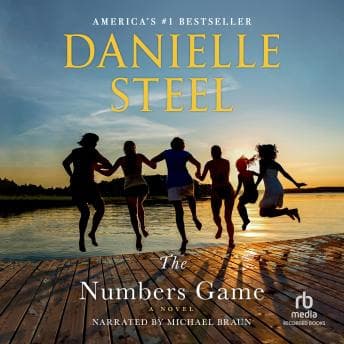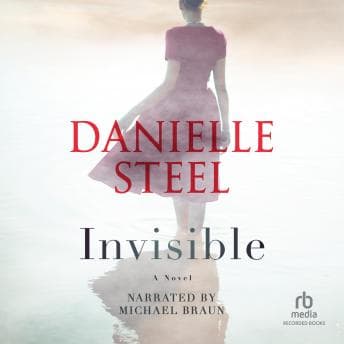

Danielle Steel writes like someone dictating a patient history - every fact stated, restated, and then stated again for the chart.
I was three hours into a dead-quiet night shift, the unit eerily still (I already knocked on wood twice, don't worry), catching up on charting and letting this play through my earbuds. And look, I wanted to like it. The premise hooked me: a girl raised by two people who had no business being parents, learning to make herself small to survive, then having to unlearn all of that to chase a dream in Hollywood. That's real. I've seen versions of that kid come through my ER. The ones who flinch when you reach for their hand. The ones who won't make eye contact with anyone in scrubs. Steel clearly understands the emotional architecture of neglect, and Antonia's childhood sections genuinely got under my skin.
But then the book kept... telling me the same thing. Over and over.
The Word "Invisible" Does a Lot of Heavy Lifting
I lost count of how many times Steel reminds us that Antonia wants to be invisible. That she learned to be invisible. That invisibility was her armor. That she was invisible to her parents. I get it. I got it on page one. By the third hour I was muttering "yes, she's invisible, we KNOW" at my computer screen, and the charge nurse gave me a look.
Here's the thing - the concept is genuinely powerful. A child who learns that disappearing is safer than being seen? That's not just a character trait, that's a survival mechanism I've watched play out in real time. But Steel handles it like she's writing a nursing care plan where you have to document the same assessment every four hours. The repetition doesn't deepen the theme. It flattens it.
Antonia's trajectory from neglected kid to reluctant movie star to aspiring filmmaker follows a path so predictable I could've charted it on a whiteboard. Famous British director falls for her. She's thrust into the spotlight. She struggles. Tragedy strikes. She has to choose between hiding and living. Every beat lands exactly where you expect it to, exactly when you expect it to. No surprises. No subversions. It reads like a template with the names swapped in.
Michael Braun Deserves a Harder Book
Here's where I'll give credit - Michael Braun is doing solid work with material that doesn't challenge him enough. His voice has this steady, warm quality that kept me listening even when the prose was making me itch. He reads Antonia with a kind of quiet restraint that actually serves the character better than the writing does. There's a gentleness to how he handles her childhood scenes that made me forget, momentarily, that I'd heard the same sentiment three paragraphs ago.
But with a cast this emotionally one-note - Antonia is quiet, her parents are cold, the director is charming - there's not much range for him to show. He's a capable narrator running at maybe 40% capacity. I've heard him on other projects and the man can do more. This book just doesn't ask him to. Boys Who Challenged Hitler gave him the kind of material that actually pushes a narrator to use every tool in his kit.
Who This Is Actually For (And Who Should Walk Away)
If you're a longtime Steel reader who knows exactly what you're getting and you want that - comforting, predictable, emotionally tidy - this will deliver. Neighbors was the same for me—a warm, formulaic hug that I didn’t have to think about. It's comfort food. It's the audiobook equivalent of reheating last night's adobo at 4 AM because you need something warm and familiar. No shame in that. Perfect for a long road trip where you want something that doesn't demand your full attention.
But if repetitive prose makes you want to throw your phone out the car window, skip this one. If you want a story about childhood trauma that actually sits in the mess and complexity of it - the way real people carry that weight - this isn't it. Pike Swimmer does the messy, complicated work this book sidesteps, and the narrator doesn’t flinch either. Steel sketches the outline but never fills in the shadows.
Carlos asked me what I was listening to when I got home. I said "a Danielle Steel." He just nodded. He knows.
The Discharge Summary
My mom would love this (she still thinks I should've been a doctor). And honestly? I didn't hate it. I just wanted it to be braver. The bones of Antonia's story deserved writing that trusted the reader to understand pain without having it explained seventeen times. Braun's narration keeps it listenable, and at 8 and a half hours it doesn't overstay its welcome. But "didn't overstay its welcome" is not exactly a ringing endorsement. Borrow it from Libby, listen while folding laundry, and move on.