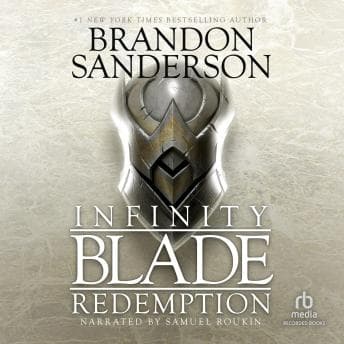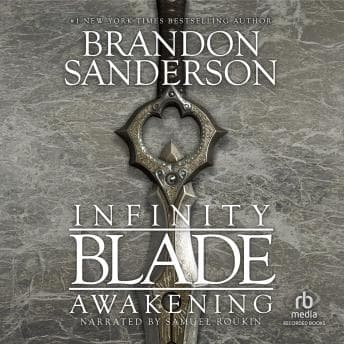

Look, I'll admit it: I had my literary snob hat firmly in place when I started this one. A video game tie-in novel? Written by Brandon Sanderson, sure, but still—my inner grad student was skeptical. I teach Dickens and Dostoevsky, for crying out loud. What am I doing listening to something based on an iOS game?
Turns out I was being an idiot. (Don't tell my students I said that.)
When Sanderson Does Sword & Sorcery
Here's the thing about Brandon Sanderson that even his critics have to admit: the man understands pacing. At just under five hours, Infinity Blade: Awakening is lean in a way his doorstop epics can't be. No 200-page magic system explanations. No seventeen-chapter political subplot. Just Siris, a young knight who accidentally succeeds at the impossible task his bloodline has failed at for generations, now completely unprepared for what comes next. If you want the full Sanderson experience with all the sprawling world-building he's capable of, Way of Kings is where he really lets loose.
And honestly? That's a compelling premise. The "chosen one who wins too early" isn't new, but Sanderson does something interesting with it. Siris isn't special because of destiny or hidden powers—he's special because he survived, and now he has to figure out why. The world-building hints at something deeper: Deathless immortals, technology indistinguishable from magic, cycles of death and rebirth that make mortality itself a question mark.
I found myself thinking about Borges, actually. The infinite library, the eternal return. (Yes, I'm that guy who finds literary parallels in video game novelizations. My podcast listeners—all 47 of them—would expect nothing less.)
The prose is accessible, almost deceptively simple. Sanderson writes like he's telling you a story over a campfire, not constructing a monument. Some might call it workmanlike. I'd call it efficient. Not every sentence needs to be Faulkner. Sometimes you just want the sword to swing.
Samuel Roukin Nails the Assignment
Now here's where I get genuinely enthusiastic. Samuel Roukin's narration elevates this from "fun fantasy romp" to "audiobook I'd actually recommend to my wife." (Denise has strong opinions about narrators. She once made me turn off an otherwise excellent historical fiction because she couldn't stand the reader's breathing patterns. We've been married 23 years. I've learned to vet these things.)
Roukin brings a theatrical precision to the character work without ever tipping into melodrama. His rolling Rs give the Deathless a weight and menace that the prose alone might not convey. Siris sounds young but not naive—there's a weariness under the determination that Roukin finds without the text explicitly stating it. That's interpretation. That's craft.
The pacing is spot-on too. Action sequences move with urgency, but he knows when to let a moment breathe. There's a scene late in the book—I won't spoil it—where the silence between lines carries as much meaning as the dialogue. Roukin understands that pause is punctuation.
I listened at my usual 1.0x speed while grading sophomore essays on The Great Gatsby. (The irony of reading about green lights and unattainable dreams while Siris chases the Worker of Secrets was not lost on me.) The production is clean, the audio quality excellent. No complaints there.
It's a Tie-In Novel, and It Knows It
I'm not going to pretend this is literature with a capital L. It's a tie-in novel, and it wears that origin openly. Some of the world-building feels like it's gesturing toward game mechanics rather than organic storytelling. The supporting characters are functional but not particularly deep. And at times, the plot moves with the straightforward momentum of, well, a video game quest.
But here's my counter-argument, the one I'd make to my fellow English teachers who'd scoff at this: not every meal needs to be a seven-course tasting menu. Sometimes you want a really excellent burger. This is a really excellent burger.
My students would probably love this. I had a similar thought when I listened to Elantris—it's Sanderson at his most accessible, perfect gateway material. And honestly, if it gets them listening to fantasy, maybe they'll eventually find their way to Ursula K. Le Guin or Gene Wolfe. You have to meet people where they are.
Class Dismissed
Probably wouldn't listen again—it's not that kind of book. But I genuinely enjoyed the time I spent with it, and I'm curious enough about the world that I might seek out the sequel. That's more than I can say for half the "serious" literary fiction I've slogged through this year.
If you're a Sanderson completist, this is essential. If you're a fantasy fan looking for something short and satisfying, it delivers. If you played the game and want more of that world, you're the target audience and you'll be happy. Skip it if you need deep character work or can't stomach video game origins—this won't convert you.
And if you're a high school English teacher who secretly needs a break from analyzing symbolism? Yeah. This works too.