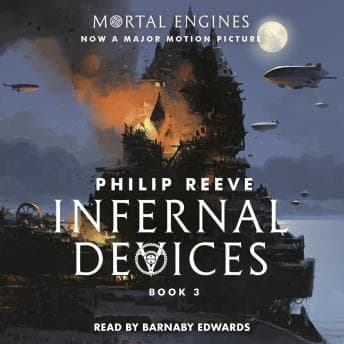

So there I was, 11:47 PM on a Tuesday, wide awake after debugging a particularly nasty race condition that had been haunting our message queue for three days. Kevin was already asleep. I was too wired to close my eyes but too fried to look at another screen. Perfect conditions for Book 3 of the Mortal Engines quartet.
Here's the thing about Infernal Devices - a bunch of listeners say it's not as good as the first two books, and I get where they're coming from, but I think they're wrong. It's different, and different isn't worse.
Wren Natsworthy Is the Variable You Didn't Know You Needed
Reeve does something gutsy here. He basically sidelines Tom and Hester - the protagonists you've been following for two books - and hands the narrative to their teenage daughter Wren. It's like when a codebase gets a major refactor: the architecture is the same, but the interface is completely new. Wren is impulsive and sheltered and desperately wants to prove she's more than the kid of two famous adventurers. She makes choices that are objectively dumb (stealing the Tin Book for a charming submarine pirate she barely knows? girl, no), but they're the exact kind of dumb that a restless sixteen-year-old would actually do. That authenticity sold me.
And the world has shifted. Anchorage is static now, rusted to the edge of what used to be America. The traction cities are still out there eating each other, but we're seeing this world from its margins. Reeve uses that shift to expand the geopolitics - the Lost Boys, the Green Storm, the whole tension between static settlements and the predator cities. It's YA fiction that doesn't talk down to you about power structures. The ROI on this audiobook is solid if you're invested in the series worldbuilding. The only other audio series I've found with this kind of ambitious, layered world-building that actually rewards close listening is To Paradise — completely different setting, same sense that the author trusts you to keep up.
Barnaby Edwards and That Stalker Hiss
Okay, let me address the split opinion on the narration. Most people love Barnaby Edwards in this series, and one reviewer literally said if it weren't for his performance they would've rated the book lower. A handful found him annoying. I'm firmly in the first camp.
Edwards does this terrifying hiss for the Stalker character that genuinely made me pull my blanket tighter at midnight like some kind of reflex. It's not a gimmick - it's this mechanical, almost insectoid quality that makes the Stalkers feel wrong in exactly the right way. His character differentiation across the cast is strong; you can tell who's speaking without needing the "said" tags, which is critical when you're listening in a half-conscious state.
That said, I can see how his style might grate on some people. He commits hard to character voices, and if one of those voices hits you wrong, you're stuck with it for 10 hours. It's like a font choice in a UI - once you notice it bothers you, you can't un-notice it. For me, it worked. His emotional delivery in the heavier scenes lands without getting melodramatic.
The Third-Book Problem (And Why This One Survives It)
Book 3 in any series is dangerous territory. The setup's done, the finale isn't here yet, and you're basically the middle child. Infernal Devices handles this by doing a soft reset - new protagonist, new geography, new conflicts - while keeping the consequences of the previous books running underneath everything. Hester's arc in particular goes to some dark places here. She's not the scrappy survivor from Book 1 anymore. She's a mother who's been shaped by violence and loss, and Reeve doesn't flinch from showing how that warps her decisions.
The pacing is steady but not breakneck. I finished it across about four late-night sessions (couldn't sleep anyway, might as well hang out in a post-apocalyptic traction city). There's a stretch in the middle where the submarine pirate plotline felt like it was treading water - pun sort of intended - but it picks up once the Tin Book's true significance comes into play and the factions start colliding.
At 10 hours, it's a reasonable commitment. Not the kind of book where you wonder why it isn't 6 hours shorter (looking at you, every business book about "10x thinking").
Who Gets a Ticket to Anchorage
If you've read Books 1 and 2, just keep going. This is a series that rewards the long game, and Infernal Devices sets up the finale in ways you won't fully appreciate until you get there. If you haven't started the series - don't start here. Go back to Mortal Engines. The worldbuilding context matters.
Skip if: you wanted more Tom-and-Hester and can't handle a protagonist swap. Or if you tried Edwards' narration before and it wasn't for you.
Perfect for: bedtime listening, long drives, or 2AM insomnia sessions when your brain is too cooked to do anything productive but too alert to sleep.
Commute-Worthiness: Solid Green Light
TL;DR: Worth your commute. It's the transitional book that every quartet needs, and it earns its place by taking real risks with new characters and darker themes. Edwards' narration carries you through the slower stretches. Not the strongest entry in the series, but the one that makes the finale possible. I finished this in 4 sessions and immediately queued up Book 4.