
Can a book with no magic system, no stat blocks, and no world-building more complex than "Canadian wilderness" still wreck you emotionally? Turns out, yeah. Yeah it can.
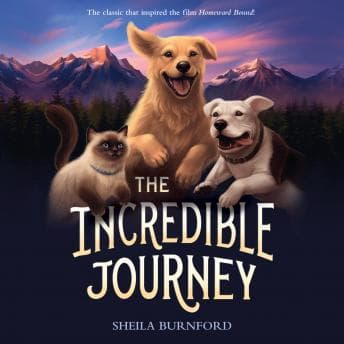
I picked this up on a whim - three hours, come on, that's basically a long podcast episode - while reorganizing my board game shelf at 1 AM because I couldn't sleep and didn't want to think about my thesis. I figured a kids' book about animals walking through the woods would be pleasant background noise. Instead I'm sitting on the floor at 2 AM surrounded by unalphabetized copies of Gloomhaven expansions, genuinely stressed about whether a Siamese cat is going to survive a river crossing.
Three Pets, Zero Dialogue, and You'll Still Care More Than Most Epic Fantasy
Here's the thing that surprised me about Sheila Burnford's writing: the animals don't talk. This isn't Homeward Bound with Michael J. Fox cracking jokes. There's no inner monologue. Burnford writes these three - the young Labrador retriever, the aging bull terrier, and the Siamese cat - as animals. They operate on instinct and loyalty and whatever mysterious compass tells them west is home. And somehow that restraint makes it hit harder. You're watching behavior, not reading dialogue, and your brain fills in the emotional weight on its own.
The bull terrier is the one that got me. He's old. He's tired. He keeps going because the other two keep going. There's something about that stubbornness - that refusal to quit when the body is clearly saying "please stop" - that felt uncomfortably relatable. (Not that I'm comparing my thesis progress to a dog limping through the Canadian wilderness. But also... kind of.)
Burnford was a WWII ambulance driver before she wrote this, and you can feel that background in how she handles physical suffering. She doesn't melodramatize it. The hunger, the injuries, the exhaustion - it's all described with this calm, observational precision that somehow makes it worse. Like she's seen enough real pain to know you don't need to dress it up.
Megan Follows and the Music That Tried Too Hard
Megan Follows has this warm, steady quality to her reading that fits the tone really well. She's not doing voices per se - again, the animals don't talk - but she modulates between the descriptive nature passages and the tenser survival sequences in a way that keeps three hours from feeling monotonous. There's a sweetness to her delivery during the quieter stretches, the passages about the animals curling up together for warmth, that feels genuine rather than saccharine.
But here's my one real gripe: whoever decided to add musical accompaniment to the action scenes made a choice. And it was the wrong one. During the more intense moments - river crossings, encounters with wild animals - there's background music that's mixed too loud relative to the narration. It's not constant, but when it kicks in, it pulls you right out of the story. Like watching a nature documentary where someone cranked the Hans Zimmer to eleven. In a three-hour audiobook, you don't need the score telling me to feel tense. The starving cat fighting a current is doing that job just fine.
Who This Is Actually For (And Who Should Scroll Past)
If you're looking for your next 40-hour epic with a hard magic system and seventeen POV characters, this obviously isn't that. But if you grew up watching Homeward Bound and want to experience the source material - which is leaner, quieter, and honestly more emotionally devastating than the movie - this is a genuinely good way to spend three hours.
Parents looking for something to listen to with kids: solid pick, but be warned, the animal suffering is real and understated in a way that might hit young listeners harder than cartoon-style danger would. No animals die (I'll give you that spoiler for free because I needed it myself), but it gets rough.
The pacing is slow early on. I'll cop to that. The first thirty minutes or so are setup - establishing the household, the owner's absence, the animals' restlessness before they bolt. If you're a 1.25x listener by default, this is a book where that speed actually works fine for the opening act, then you might want to drop back to normal once the journey starts and Burnford's nature writing deserves a little more breathing room.
Roll for Emotional Damage
I read this instead of writing my thesis, and I'd do it again. Three hours. That's nothing. That's one session of D&D combat when the party can't agree on initiative order. And yet Burnford packs more genuine tension and earned emotional payoff into this slim story than books ten times its length. No magic system. No progression mechanics. Just three animals walking home because they love someone, and somehow that's enough. Whirligig gave me a similar gut-punch with similarly minimal setup - just a kid moving through American landscapes carrying grief, and somehow that's also enough.
My D&D group would love this - at least the ones who cried when our ranger's wolf companion went down in session 47. You know who you are, Marcus.