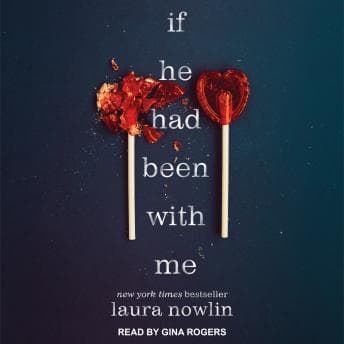

How much of regret is love, and how much is the mind trying to negotiate with something it cannot change? I was folding dough around potato filling at my kitchen counter when that question started crowding out dinner. Laura Nowlin’s If He Had Been with Me is practically an invitation to counterfactual thinking: take one relationship, change one decision, imagine an entirely different life. The samosas required sealed edges. Autumn and Finn’s relationship had rather more openings.
My buying advice: wait for a sale. There’s recognizable adolescent psychology here, and Gina Rogers gives Autumn’s perspective a gentle, clear delivery. But the 8-hour-37-minute audiobook asks you to tolerate a long stretch of emotional hesitation before its late escalation. I appreciated what Nowlin was examining more consistently than I enjoyed the pace at which she examined it.
Autumn has Jamie. That doesn’t settle anything.
The detail that matters isn’t simply that Autumn and Finn used to be inseparable. It’s that they’ve become people who try to ignore each other while remaining acutely conscious of each other. That distinction is the engine of this romance. Indifference would end the book considerably earlier.
Autumn has Jamie and her own close-knit circle; Finn has become socially desirable, the boy other people want around. Those separate identities give their distance a believable function. I kept thinking of Art of Seduction (Unabridged): An Indispensible Primer on the Ultimate Form of Power, although Greene treats social desirability as strategy where Nowlin makes it feel like adolescent self-protection. Reconnecting wouldn’t just mean admitting attraction. It would mean questioning the versions of themselves they’ve established in front of other people.
That’s where I found Nowlin most persuasive. Adolescents don’t always choose the relationship they want most; sometimes they choose the one that makes their current identity easiest to maintain. You don’t need to diagnose Autumn with an attachment style to recognize the defensive usefulness of avoidance. If neither person asks the dangerous question, neither has to absorb an explicit rejection. A workable arrangement. Until it isn’t.
Some listeners find Autumn annoying. I understood the irritation without entirely sharing the judgment. Having a boyfriend doesn’t switch off an unresolved attachment, and possessing feelings doesn’t automatically produce the vocabulary—or courage—to explain them. Her divided attention makes psychological sense.
But psychological plausibility and narrative momentum are different criteria. I wanted more weight placed on the history that made Autumn and Finn’s attachment so difficult to dislodge. Their former closeness supplies the premise; I sometimes wanted it to supply more of the evidence. Without enough of that foundation, repeated hesitation can feel less like accumulating insight and more like waiting for someone to finish a sentence.
Rogers keeps Autumn close, sometimes too level
The split in listener responses to Gina Rogers makes sense to me. Her warmth and clarity suit a story filtered through private uncertainty rather than outward action. She doesn’t make every troubled feeling sound like a formal announcement, which helps preserve Autumn’s adolescent vulnerability.
And yet the criticism of monotony isn’t unfair. There’s a relatively level quality to the delivery that, paired with Nowlin’s slow buildup, can flatten the difference between reflection and forward movement. I didn’t need a more theatrical Autumn. I did want more rhythmic contrast across all that circling around Finn.
This is an important distinction if you’re choosing between formats. A measured voice can make emotional material feel less manipulated; the same restraint can also lengthen your experience of scenes that already depend on withholding. Rogers gives you tenderness, not much propulsion. Whether that’s a benefit will depend on how willingly you inhabit Autumn’s indecision.
The production itself is clean, with no distracting noise or troublesome volume shifts reported in the research. My reservation concerns the performance’s range and pace, not recording quality. Try the sample before committing. If Rogers’s cadence feels sleepy rather than intimate to you, the romantic stakes probably won’t erase that response.
Before you follow Autumn into August
Readers who praise the ending and readers who complain about the slow approach aren’t necessarily disagreeing. Both reactions can be true. Nowlin builds the book around the possibility of a different outcome, then makes that possibility emotionally expensive. The approaching August gives the title’s conditional wording its pressure.
What interested me most was the distinction between regret and responsibility. Counterfactual thinking—imagining what would have happened if one thing had changed—can create a feeling of control after distress. But imagining a preventable outcome isn’t proof that someone could actually have prevented it. I wouldn’t treat Autumn’s emotional logic as an objective account of causation. Nor would I mistake this for self-help, despite that category appearing in the listing. This is YA romantic tragedy, not guidance for processing grief.
Listen if you want unresolved childhood closeness, adolescent identity, and romantic longing examined at an unhurried pace. Skip if you need frequent plot developments or want the reassurance of a conventional romance ending. Content considerations include depression, emotional distress, family problems, sexual content, and pregnancy.
For me, the attachment was more convincing than the pacing was satisfying. A discounted listen, with room afterward to question that title. “If” can explain a longing. It cannot establish a fact.