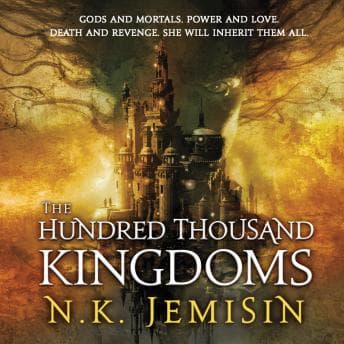
Okay, I have a complaint. Not about the book - the book is extraordinary. My complaint is about myself, specifically the version of me who thought it was a great idea to start this one on my lunch break at the library, wedged between the periodicals section and a display of Large Print Westerns, eating a sad desk sandwich. Because Hundred Thousand Kingdoms does not want your half-attention. It will not accept it. Yeine's voice pulled me in so hard I forgot to eat for forty minutes, and then a patron asked me where the bathroom was and I genuinely could not locate language for a moment.
This is Jemisin's debut. Her debut. Shirley Jackson walked so this author could run.
When Gods Are the Monsters (And Also the Victims)
Here's what I wasn't prepared for: the gods in this book are enslaved. Not metaphorically. Literally collared, bound, weaponized by a mortal ruling family who won some ancient war and decided the spoils included divine beings. Nahadoth - the god of night and chaos - is kept leashed in human form during the day, only released into his actual nature after sundown. That detail. That specific, horrifying detail. The idea that something vast and primordial is spending its daylight hours in a body that doesn't fit, constrained by the whims of people who are, cosmically speaking, mayflies. Horror doesn't need to call itself horror to understand dread. This book understands that completely.
And then Jemisin does something I didn't see coming: she makes you feel for them. The gods aren't just set dressing or power sources. They're damaged. Angry. Occasionally tender in ways that feel genuinely dangerous. The relationship that develops between Yeine and Nahadoth is the kind of thing that should not work on paper - mortal woman, enslaved chaos deity, political intrigue, ticking clock - and yet it does, completely, because Jemisin never lets you forget what's at stake or what's been lost.
The narrative structure is also doing something unusual. Yeine is telling us this story after the fact, from a position we don't fully understand until the end, and she keeps interrupting herself, correcting herself, admitting she doesn't know how to explain what happened. It's fragmented in the best possible way. It reads like memory under pressure. Like someone trying to describe a dream before it dissolves.
The Voice in the Room (And Where It Falls Short)
Casaundra Freeman has a clear, strong alto that is genuinely well-suited to Yeine's register - there's a steadiness to it that works for a narrator who's processing trauma in real time while also navigating a court that wants her dead. The character differentiation is solid. The gods sound different from the mortals. The women sound different from the men. Freeman handles the range without it ever feeling like a party trick.
But. Here's my thing. There are moments in this book that should crack you open, and Freeman sometimes delivers them at the same temperature as the quieter scenes. The emotional ceiling feels lower than the text demands. When Yeine confronts something genuinely shattering - and she does, more than once - I wanted the narration to fracture slightly, the way the story itself fractures. Instead it stays composed. Controlled. Which is a valid interpretation of Yeine's character, I'll grant that, but it occasionally creates distance when the book is trying to close it.
This isn't a dealbreaker. It's more like... the performance is very good when it should be extraordinary. Freeman commits to the material, which is not nothing - plenty of narrators treat fantasy as background noise and you can hear it. She doesn't. But I kept wanting one more degree of rawness.
Check It Out (Or Don't, But You Should)
If you've already done The Broken Earth trilogy and you're wondering whether to go back to Jemisin's earlier work: yes. Hundred Thousand Kingdoms is less structurally complex than The Fifth Season, but it's doing its own distinct thing with voice and myth and power, and it does it well. If you're new to Jemisin entirely and someone told you to start here - also yes, this is a reasonable entry point, just know that the world-building asks for your full attention especially in the first few hours.
If you need your fantasy to have clear heroes and uncomplicated magic systems, this will frustrate you. I ran into something similar with Thief of Dreams, where the moral ambiguity kept me off-balance in ways I wasn't expecting from the cover. The gods are morally complicated. The power structures are deliberately ugly. The love story is genuinely strange. These are features, not bugs, but know yourself.
My podcast listeners are going to love this. Shirley (my cat) was unimpressed. I was completely absorbed. Listened to the last two hours after midnight with the lights low because that's the only way this story wanted to be finished, and I don't regret a single minute of it.