
"Attitude is everything, and everything starts with your attitude."
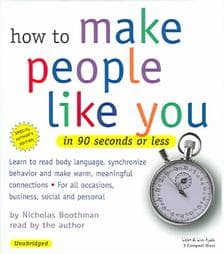
So here's the thing about business self-help audiobooks: most of them could've been a Medium post. Maybe two. I went into this one fully expecting to bump up my playback speed to 1.75x and zone out somewhere around the Golden Gate Bridge. But Nicholas Boothman's How to Make People Like You in 90 Seconds or Less actually... held my attention? At 1.5x, even. Which for a 3-hour self-help book is basically a standing ovation from me.
The NLP Guy Who Actually Sounds Like a Human
Boothman narrates this himself, and that's both the strength and the weakness here. On the plus side, you're getting the content straight from the source—a former fashion photographer turned NLP practitioner who's clearly spent decades thinking about first impressions and rapport. There's an authenticity to hearing him explain his "Really Useful Attitude" framework that you just wouldn't get from a professional narrator reading his words.
But—and this is a real but—the pacing is... leisurely. Like, "I've had my coffee and I'm in no rush" leisurely. Some mornings on the Caltrain when I was already half-asleep, this worked fine. Other times I found myself mentally debugging production issues instead of absorbing the content. His delivery is warm and clear, just not exactly dynamic. No Ray Porter energy here. (Yes, I compare everyone to Ray Porter. It's a problem.)
VAK and Other Actually Useful Mental Models
The core idea: you've got roughly 90 seconds to make someone like you. Boothman breaks this down into components that are actually useful if you're, say, an engineer who spends more time talking to distributed systems than humans. (Not that I'd know anything about that.)
The VAK model—Visual, Auditory, Kinesthetic—is the meat of this thing. People process the world differently, and if you can figure out whether someone "sees what you mean" versus "feels you" versus "hears you loud and clear," you can mirror their language patterns and build rapport faster. Is this groundbreaking neuroscience? No. Is it a useful mental model for that awkward moment when you're networking at a conference and desperately trying to connect with someone who clearly processes information completely differently than you? Yeah, actually.
The stuff about open body language, synchronizing movements, and using "opening" versus "closing" words is pretty standard communication advice. But Boothman packages it in a way that's immediately applicable. I caught myself consciously uncrossing my arms in my next 1:1 with my manager. (Did it help? TBD. But at least I was thinking about it.)
Where to Hit 2x Speed
Some parts are repetitive. He'll make a point, then make it again with a slightly different example, then summarize. Classic self-help padding. This is where I'd recommend bumping to 1.75x or even 2x if you're comfortable. The production quality is clean enough that you won't lose anything at higher speeds.
The exercises he suggests—like practicing your "Really Useful Attitude" in front of a mirror—are fine, I guess? I didn't actually do them. (Don't tell my productivity podcast hosts.) But if you're someone who actually implements self-help advice instead of just consuming it, they're there.
My bigger issue: Boothman occasionally veers into territory that feels dated. The examples sometimes have that "written in the early 2000s" energy. While the core principles hold up, some scenarios feel like they're from a different era of professional interaction. We're not all doing cocktail party networking anymore—half my "first impressions" happen over Zoom with my camera strategically angled.
The ROI Calculation
Here's my honest assessment: if you're already pretty socially fluent, this book will feel like a refresher course. Useful, but not revelatory. If you're someone who finds initial interactions genuinely challenging—or if you're in a role where you're constantly meeting new clients, interviewing, or networking—the ROI is higher.
I finished this in about 2 commutes (with some skipping during the more repetitive bits). For a 3-hour investment, I walked away with maybe 3-4 genuinely useful frameworks I'll actually remember. That's... not bad? First 90 Days gave me a similar ratio of actionable frameworks to total runtime, though that one skews more toward career transitions than first impressions.
Queue it if: you find first impressions genuinely challenging, you're in a client-facing or interview-heavy role, or you want a quick primer on rapport-building basics. Skip if: you're already socially fluent and looking for advanced techniques—this will feel like review.
Perfect for: commute, gym, doing dishes. Skip for: anything requiring deep focus—you'll zone out during the slower sections.
Would I recommend it? If you're looking for a quick, practical primer on first impressions and you don't mind author-narrated content that's more "warm uncle explaining life" than "polished performance," sure. Just keep your finger on that speed button.