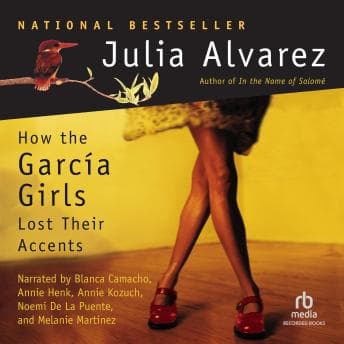

Julia Alvarez wrote a novel that moves backward through time, and I'm still not sure if that's brilliant or infuriating. Maybe both. I was listening to the final chapters - which are actually the earliest moments in the Garcia family's story - while Denise and I walked the lakefront on a Sunday morning cold enough to make my ears sting, and something about the chill matched the ache of it. By the end, you're not at a resolution. You're at a beginning. And that beginning feels like a wound that hasn't happened yet.
This is a book that demands comparison, so let me make the obvious one: if Sandra Cisneros gave us the immigrant experience in vignettes like polaroid snapshots in The House on Mango Street, Alvarez gives us something more like a family photo album someone dropped down the stairs. The pictures are scattered, out of order, and you have to piece together which sister is which and what year you're in. It's disorienting. It's also kind of the point.
The Reverse Chronology Gamble
Let's talk about what Alvarez is really doing with that backward structure. The novel opens with adult Yolanda returning to the Dominican Republic, asking her aunts about guavas - this small, almost silly detail that carries the entire weight of displacement. Where did the taste go? Where did the self go? Then the book peels back, chapter by chapter, decade by decade, until you're watching these girls as children in Santo Domingo before the family's political exile. Most novels build toward a climax. This one builds toward innocence. The only other audiobook that's done something similarly disorienting to my sense of time and momentum is Count of Monte Cristo, where the weight of the whole story keeps shifting under your feet the longer you listen. And that reversal does something strange to your chest - you're watching people unknow things, unlearn their American selves, and it hits different than a forward-moving narrative ever could.
But here's the honest part: the structure also means you spend the first few hours without a clear anchor. You're meeting the Garcia sisters as adults with their divorces and identity crises and therapy sessions, and you don't yet have the childhood context that makes those adult fractures meaningful. Alvarez trusts you to hold the confusion. Some listeners won't want to.
Five Narrators, Four Sisters, One Problem
The audiobook uses five narrators - Blanca Camacho, Annie Henk, Annie Kozuch, Noemi De La Puente, and Melanie Martinez - and this is where I have to be straight with you. The Spanish pronunciation is gorgeous. When the Spanglish kicks in, when a character's accent thickens around a word like "mija" or rolls through a Dominican phrase, it sounds right. There's an authenticity to the language switching that a single non-Latina narrator couldn't have pulled off.
But the narrators share a problem: they sound too much alike. With four sisters plus parents plus aunts plus cousins rotating through the story, and with the timeline jumping around, I needed the voices to function as road signs. They don't. The narrators are expressive, their emotional reads are solid, but I kept losing track of whose chapter I was in. Is this Yolanda or Sandi? Am I hearing the same narrator as two chapters ago, or a different one? The prose deserves to be savored, and I found myself rewinding more than I'd like to admit - not because the writing was unclear, but because the vocal performances weren't distinct enough to do the navigation work the structure demands.
This is the kind of book where a full-cast production with sharply differentiated voices would've been transformative. What we got instead is five competent, warm, occasionally beautiful performances that blur together at the worst possible moments.
What Hemingway Never Had to Write About
This reminds me of what Hemingway said about writing - that the dignity of an iceberg is in what's beneath the surface. But Hemingway never had to write about being caught between two languages, two countries, two versions of yourself. Alvarez's submerged material is different. The Garcia parents' traditionalism isn't just conservative - it's survival instinct calcified into rigidity. The girls' rebellion isn't just American teenage defiance - it's the terror of becoming someone your parents can't recognize. That tension between Mami and Papi's old-world expectations and the daughters' messy American assimilation doesn't resolve. It just... continues. My students would hate this. I love it.
If you loved The House on Mango Street, this is its spiritual successor - longer, more novelistic, more willing to sit in the uncomfortable space between cultures without offering easy answers. It's also a natural companion to Junot Díaz's Drown, though Alvarez's voice is warmer, more domestic, less aggressive in its grief.
Who Gets the Assignment
This is for readers who want literary fiction about the immigrant experience and don't mind working for it. If non-linear timelines frustrate you, or if you need a strong narrative throughline to stay engaged, this audiobook will test your patience - especially with the narrator confusion on top of the structural complexity. Not background listening. Not a commute book unless your commute is long and quiet. This one needs your full attention.
But if you're willing to sit with the disorder, to let the pieces assemble themselves slowly in your mind like a mosaic viewed from increasing distance - worth pausing the faculty meeting for.
The Notation in the Margin
Nine hours and thirty-eight minutes, and what stays with me isn't a single scene but a feeling: the particular loneliness of being fluent in two languages and fully understood in neither. Alvarez wrote that feeling thirty years ago and it hasn't aged a day. The audiobook doesn't quite rise to the level of the prose - those narrator issues are real - but the source material is strong enough to carry even a flawed production. This is why we still read the classics. Even the ones that aren't old enough to be called classics yet.