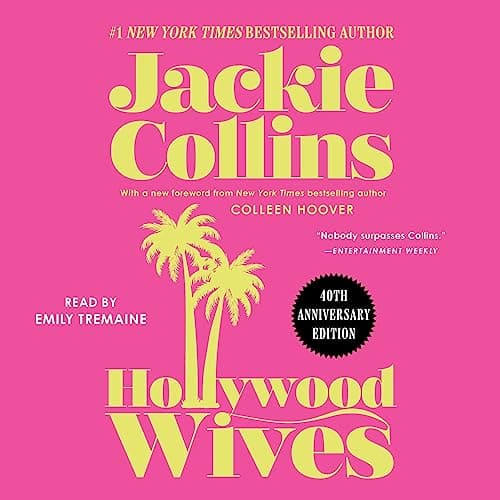

"She was a woman who knew what she wanted and went after it with a vengeance." That line lands somewhere in the first few hours of Hollywood Wives, and it could describe any of the three women at the center of Jackie Collins' sprawling 1983 blockbuster. It could also describe Collins herself.
I listened to this 40th anniversary edition across a week of Saturday chores and weeknight commutes, and what kept pulling me back wasn't the scandals or the sex scenes—it was how precisely Collins understood the machinery of status anxiety. I've spent enough time around industries where your worth is measured by your last project to recognize what she's doing here. She's not just writing about Hollywood. She's writing about the universal terror of becoming irrelevant, dressed up in Gucci and served poolside.
Hollywood Wives follows three women orbiting the entertainment industry at different altitudes. Elaine Conti is married to a once-famous actor and has made his career revival her full-time project, bulldozing through every social event and power lunch with the ferocity of a talent agent on commission. Angel Hudson is the sweet, naive young wife of a rising star who has no idea what kind of predators populate her new world. And Montana Grey is the ambitious filmmaker trying to claw her way behind the camera in an industry that would rather she stay in front of it—or better yet, in someone's bed. Collins braids these storylines together with a soap-opera architect's precision, layering betrayals, affairs, and power plays until the whole thing builds to a genuinely surprising climax.
At 22 hours, this is a marathon listen, and the pacing mirrors an '80s miniseries—which makes sense, since the book became one. There's slow, deliberate character building that pays off in bursts of scandal and shock. Some listeners have called the storyline predictable, and they're half right: you can see certain betrayals coming from a distance. But Collins' skill isn't in surprising you with what happens. It's in making you care about characters you probably shouldn't root for, then watching them self-destruct in spectacular fashion.
So let me be blunt about who should buy this and who should skip: if you can handle a 22-hour soapy Hollywood saga and enjoy morally messy women, old-school scandal, and deliberate setup, this audiobook is worth your time and your credit. Skip it if you need tight pacing, subtle narration, or you get impatient with melodrama and 1980s gender politics that sometimes read as time capsules rather than commentary.
Emily Tremaine's narration is where opinions split hard, and I find myself planted in the middle. She commits fully to the material's inherent melodrama, delivering Ross Conti's lines with cinematic exclamations that feel pulled from a Dynasty script read-through. When the text calls for histrionics, she leans in without apology, and I respect that choice. One listener described being able to "read along word for word" with her delivery, which speaks to how closely she honors Collins' prose rhythms. But the criticism has merit too. Some listeners wanted a male narrator for a book with so many prominent male characters, and Tremaine's approach to the men doesn't always land with the same authority as her work with the women. She's strongest with Elaine's Bronx-born hunger and Montana's cool defiance. She's less convincing when voicing Hollywood's sleazy power brokers. If you're sensitive to narrator performance, bump the speed to 1.25x—it tightens the delivery and helps the slower stretches move.
I noticed the same strengths and limitations in Tremaine's work on Pretties—she's magnetic with complicated female characters but occasionally loses authority when the male voices take center stage.
The Colleen Hoover foreword is brief and functions more as a celebrity endorsement than analysis, but hearing her genuine enthusiasm for the book sets a warm tone before Tremaine takes over.
What struck me most, listening to this decades after its original publication, is Collins' understanding of the specific loneliness that comes with being defined by someone else's success. Elaine doesn't have an identity apart from her husband's career. Angel doesn't have the tools to build one. Montana has the talent and vision but lives in a system designed to strip both away. Collins writes about these women with empathy and edge in equal measure—she's not mocking them, but she's not letting them off the hook either. There's real craft underneath the sexy, scandalous surface.
The sexual content is frequent and frank, very much in Collins' signature style. If that bothers you, this isn't your book.
This works best as a dedicated commute listen or during housework where you can stay engaged—the character threads are complex enough that pure background listening will leave you lost. It's an imperfect audiobook with an uneven narrator and pacing that asks for patience, but as a sprawling, addictive portrait of wealth, ambition, and the lies people tell to survive in an industry built on illusion, Hollywood Wives still delivers. Collins knew this world, and she wrote about it with the confidence of someone who'd watched the whole circus from the best seat in the house.