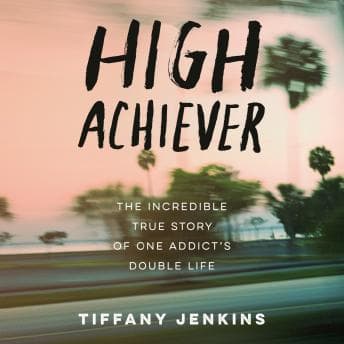

Look, I've sat through a lot of addiction memoirs. Professionally, I've seen addiction destroy companies—watched a CFO embezzle $2 million to feed a gambling habit, seen brilliant founders flame out on coke. So when I picked up High Achiever, I wasn't expecting to learn anything new. I was wrong. And I was also right. It's complicated.
The ROI on Raw Honesty
Here's the thing about Tiffany Jenkins narrating her own story: there's no filter. No actor interpreting her shame, no polished voice smoothing over the ugly parts. When she describes withdrawing on a jail cell floor while the guards—her boyfriend's coworkers, people she'd partied with—watched with barely concealed disgust? You hear it in her voice. That specific cocktail of humiliation and defiance. My parents never talked about their struggles running the dry cleaning business, but I recognized that tone. The "I know what you think of me, and I'm going to tell my story anyway" energy.
The audiobook runs about 9 hours, and honestly? You could trim 2 hours and not lose much. There's padding. Some of the dramatic recreations of conversations feel... performed. Like she's doing a bit. (And she is—Jenkins is a social media influencer, and that showmanship bleeds through.) But when she stops performing and just tells the story? That's when 2.0x speed wasn't fast enough. I actually slowed down for parts. That never happens.
Where the Business Brain Kicks In
I couldn't help analyzing this through a systems lens. Addiction is a process failure, right? And Jenkins maps her failure cascade with surprising clarity. The boyfriend who was a deputy sheriff. The access to evidence rooms. The blackmail from an ex. Each decision point where she could've course-corrected but didn't. It's like watching a startup death spiral in slow motion—you can see exactly where the red flags were, but hindsight's cheap.
What got me was how she frames recovery. Not as a moment of clarity or some inspirational breakthrough. More like... a slow rebuild of operational capacity. Learning to function without the substance that had become her operating system. My wife Jenny would say I'm being clinical about something deeply human. She'd be right. But Jenkins herself is clinical at times—she's got distance from her story now, and it shows. Sometimes that distance creates insight. Sometimes it creates a weird detachment that made me wonder if I was getting the real story or the polished-for-the-podcast version.
The Authenticity Question
Some reviewers call this book "self-serving." Yeah, okay. But what memoir isn't? The question is whether the self-service comes with genuine insight or just excuse-making. Jenkins lands somewhere in the middle. She takes responsibility—repeatedly, almost performatively—but there are moments where the narrative convenience feels too neat. The drug dealer with the heart of gold. The recovery that sticks. The social media success that followed.
I've worked with enough founders to know that survivor stories always get smoothed at the edges. The ones who failed don't write memoirs. So there's selection bias baked into the genre. Jenkins is aware of this, I think. She undercuts her own inspirational moments with dark humor that actually lands. When she jokes about her mugshot, it's not glossing over—it's coping mechanism made audible.
Worth the Hours?
This isn't a literary memoir. If you want Cheryl Strayed, look elsewhere. For that kind of polished transformation narrative, Think and Grow Rich delivers the formula—though it lacks the raw honesty Jenkins brings. This is a storyteller who lived something insane and learned to package it. The packaging is sometimes too slick, the runtime too long, the dramatic beats too practiced. But the core? The actual experience of addiction as a logic that makes sense only from the inside? That's real. And Jenkins delivers it with her own voice, which matters more than I expected.
My parents worked 14-hour days and never talked about what it cost them. Jenkins spent years destroying her life and won't shut up about it. Somehow, both approaches are valid. The difference is that Jenkins' approach might actually help someone recognize themselves before they hit the jail cell floor.
Who should listen: Anyone with a loved one fighting addiction, or anyone curious about how a functional life unravels one "reasonable" decision at a time. Who should skip: If you need literary prose or can't tolerate influencer energy in your memoirs, this'll grate.
Skip the first chapter—it's setup you don't need. The real story starts when the cuffs go on. Just maybe not at 2.0x.