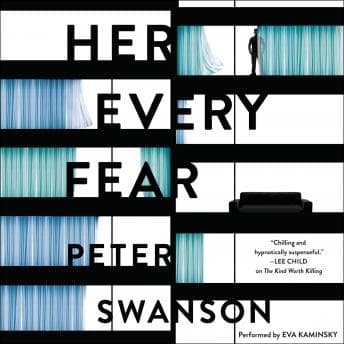

Peter Swanson knows exactly what Hitchcock knew: the scariest thing isn't the monster—it's the apartment next door.
I started Her Every Fear during a late Sunday walk along the lakefront with Denise, and within twenty minutes I'd stopped talking to her entirely. She didn't mind. She said I had "that face"—the one where I'm somewhere else completely. She was right. I was in a Beacon Hill apartment complex, watching a woman named Kate Priddy try to hold herself together in a dead woman's neighborhood, and I was genuinely unsettled.
The Rear Window Problem (And Why Swanson Almost Solves It)
The Hitchcock comparisons in the marketing aren't wrong, but they're not quite right either. This is less Rear Window and more Gaslight filtered through a post-Gone Girl lens. Kate Priddy isn't just watching—she's being watched, manipulated, and slowly convinced she can't trust her own instincts. Swanson does something clever here: Kate has a clinical anxiety disorder, a history of trauma from an ex-boyfriend who kidnapped her, and she's jetlagged in a foreign city. So when she starts suspecting everyone around her, we don't know if she's perceptive or spiraling. That ambiguity is the engine of the whole book.
The multiple POV structure—Kate, Corbin, Alan, and a few others—is both the book's best trick and its most frustrating habit. Swanson uses it to dole out information asymmetrically. You'll know something about Alan that Kate doesn't, or you'll get a Corbin chapter that reframes everything you assumed. As a teacher who spends half his life explaining unreliable narration to juniors who just want to know "but what actually happened," I appreciated the craft. But—and this is real—there were moments where a chapter break yanked me out of genuine tension just to catch up with a character I cared less about. That pacing issue is the one structural flaw I kept bumping against. The suspense builds, builds, and then the book says "hold on, let's check in with someone else for twenty minutes." It's like someone pausing a movie right before the door opens.
The disturbing details Swanson plants in Corbin's apartment—objects Kate discovers that shift her understanding of who her cousin really is—are effective precisely because they're specific and domestic. I won't spoil them, but there's a quiet, creeping horror in realizing that the person whose bed you're sleeping in, whose kitchen you're using, might be capable of terrible things. That's the stuff that lingered with me.
Eva Kaminsky Knows That Fear Lives in the Throat
Here's where I want to give real credit. Eva Kaminsky's performance carries this book through its structural wobbles. She voices Kate with this thin, slightly breathless quality during the panic attack scenes—not theatrical hyperventilation, but the kind of tight, controlled voice of someone trying very hard not to fall apart in public. If you've ever taught a student mid-anxiety attack, you know that voice. It's quiet. It's precise. It's barely holding.
Her transitions between the POV characters are clean. Corbin gets a flatter, more controlled register—almost clinical—which is exactly right for what Swanson's doing with that character. Alan's sections feel warmer, more open, which makes you want to trust him. And that's the point. Kaminsky is making interpretive choices that serve the plot's misdirection, not just reading words off a page. The narrator understands that pause is punctuation. There's a moment late in the book—a revelation scene—where she lets a silence sit for just a beat longer than comfortable, and it hit me like a cold hand on the back of my neck.
I listened at 1.0x. Obviously. The prose deserves to be savored, even in genre fiction. Especially in genre fiction.
Who This Is Actually For (And Who Should Walk Away)
If you loved Patricia Highsmith's The Talented Mr. Ripley—that slow, sick feeling of watching someone charm their way through darkness—this is its spiritual successor in modern dress. If you want a puzzle-box thriller where every character might be lying, and you're okay with the pacing occasionally sacrificing momentum for architecture, you'll enjoy this. It's sharp, it's cold, and it's smarter than it needs to be. That same cold intelligence—the sense of dread built through character rather than spectacle—runs through Depth of Winter, which manages a similar trick of keeping you unsettled even when the plot slows down.
Skip it if you need your thrillers at full sprint. The multi-POV structure genuinely does interrupt tension at key moments. And there are brief, disturbing lines involving animal cruelty (no actual harm depicted, but enough to make you wince) and heavy anxiety/trauma content that could be rough for some listeners.
One content note for my fellow pet owners: those animal cruelty references are used as character signals, not gratuitous detail. But they're there.
Worth Pausing the Faculty Meeting For
I finished this at 11 PM on a Tuesday, grading papers with one earbud in, and I genuinely forgot about the stack of sophomore essays on The Great Gatsby sitting next to me. (Sorry, period 4. You'll get them back eventually.) Peter Swanson writes the kind of psychological thriller that respects its reader's intelligence while still delivering the gut-punch moments you came for. Kaminsky's performance elevates the material from good to genuinely unsettling. Not a perfect book—that pacing issue is real—but a very, very good audiobook. And sometimes that's the better thing to be.