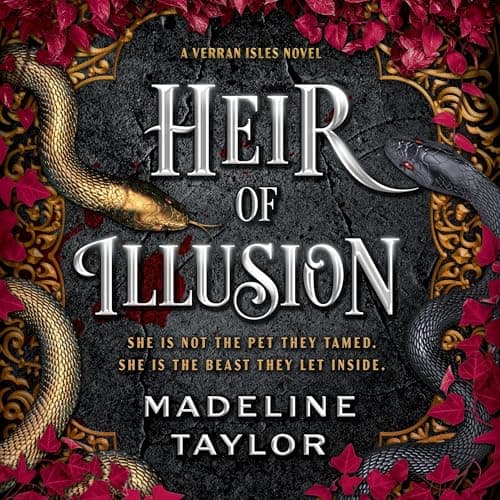
What happens when you take a fae assassin in a magical collar, pair her with a grim reaper whose touch is literally fatal, and then have the audacity to make them want each other? You get the kind of premise that makes me sit up at 1 AM with Shirley curled on my chest, whispering "okay, I see you" to my headphones like a person who has fully lost it.
I came to Heir of Illusion sideways. A listener DM'd me after episode 207 — the one where I ranked romantasy subgenres by how much they actually commit to their horror elements — and said, "Jordan, this one doesn't flinch." Bold claim. I've been burned before by books that promise dark romantasy and deliver... what, a brooding male lead and one scene in a dungeon? That's not dark. That's ambiance. Oathbringer is one of the few fantasy books I've encountered that actually earns its darkness rather than cosplaying it — so when a listener tells me something else clears that bar, I take the claim seriously.
Madeline Taylor, though? She understood the assignment.
The Collar Is Doing More Work Than Most Fantasy Worldbuilding
Ivy's enchanted collar isn't just a plot device — it's the book's entire thesis on power, autonomy, and the violence of ownership dressed up as devotion. The fact that she's simultaneously the king's assassin and his "pet" creates this suffocating dynamic that Taylor doesn't shy away from. There's real menace here. The scenes where Ivy performs obedience while plotting murder in the same breath hit differently than your standard "rebellious heroine" arc because the book earns her rage. She's not snarky for flavor. She's furious because someone literally controls her body.
And then Thorne shows up — this death-touched reaper who can't be touched without killing whoever does it — and the tension shifts from political to achingly physical. The slow burn isn't just "will they or won't they." It's "they literally cannot, and what does that do to two people who are starving for connection?" That's horror-adjacent storytelling, and I'm here for it.
Two Narrators, Two Entirely Different Hungers
Zara Hampton-Brown handles Ivy's POV with this coiled, restrained fury that only cracks when it should. Her delivery during the banter scenes — and listen, the banter in this book made me pause the audiobook to collect myself more than once — has this edge where you can hear Ivy enjoying the verbal sparring even as she's calculating escape routes. Will Watt's Thorne is quieter, more measured, with this undercurrent of exhaustion that makes sense for someone who's been a walking death sentence. The narrators commit. That's rare. They don't just alternate chapters — they create two distinct emotional registers that make the POV switches feel like tonal gear shifts rather than just voice swaps.
The banter specifically benefits from the dual narration. When you hear Ivy's internal reaction to something Thorne says in Hampton-Brown's voice, and then switch to Watt delivering Thorne's equally wrecked internal monologue? It builds this delicious dramatic irony where you know both of them are falling apart and neither will admit it. At sixteen hours, the book has room to let those moments breathe, and the pacing — which is genuinely propulsive for something this long — never lets the tension go slack.
Where the Shadows Don't Quite Reach
Here's where I pull back slightly. The "shadow daddy" trope (the book's own marketing, not my phrase, though I respect the honesty) occasionally tips from atmospheric into territory that felt more romance-convention than organically dark. A few of the plot twists land hard — genuinely didn't see one particular betrayal coming around the midpoint — but others rely on withholding information in ways that felt convenient rather than earned. And the content warnings are real: abuse, past sexual abuse, torture. Taylor doesn't use these as shock value, which I appreciate, but if you're sensitive to these themes, know that they're woven into the fabric of Ivy's backstory, not just mentioned in passing.
I also want more from the worldbuilding in subsequent books. The fae politics and the reaper mythology hint at something sprawling, but this first installment is so focused on Ivy and Thorne's dynamic (understandably) that the larger world feels sketched rather than built. That's a setup problem, not a quality problem, and I'm betting the sequel delivers.
Shelve It Next to Your Dog-Eared Copy of Flame and Sparrow
If you scare easily, skip. If you don't, you need this — but also, this isn't pure horror. It's romantasy that respects the dark half of that equation. Shirley Jackson walked so Madeline Taylor could run... in heels, through a throne room, with a knife behind her back. My podcast listeners are going to love this, specifically the ones who've been begging me to cover more fantasy-horror crossover.
I listened to the last three hours in the dark. Mistake? Maybe. Worth it? Absolutely. Shirley (my cat) was unimpressed. I was gripping my blanket like it owed me money.