
"Me and that word didn't exist, and I had come to terms with that."
That line hit me somewhere around hour two, right when I was sitting in the back row of our district's professional development seminar on "Culturally Responsive Pedagogy" — which, for the record, I'm all for, but the presenter was reading bullet points off a slide deck. So I had one earbud in, Zoya's voice threading through my head while I nodded along to something about differentiated instruction. And I'm thinking: this woman is describing emotional death with the casual clarity my students use when they talk about their real lives. Not literary language. Not Faulkner's labyrinthine sentences. Just blunt, unvarnished truth about what happens when love gets ripped away before you learn how to hold it.
I need to be upfront about something. I came to this book as a tourist. Urban romance isn't my usual lane — I live in Austen and Baldwin and Morrison, and my podcast has exactly zero episodes on street lit. But twenty years of teaching on the South Side means I know these voices. I know Zoya. I've had Zoya in third period, arms crossed, jaw set, daring me to make her care about anything. And Jahquel J. writes her with that specific combination of hardness and hunger that I recognize from real people, not characters.
Goon's Love Language Is the Whole Point
What surprised me — and this is the discovery I wasn't expecting — is how much this book is actually about emotional fluency. Goon talks about physical touch as his love language with zero irony. He's not performing sensitivity. He's a man who kisses his mother on the cheek before leaving the house and will absolutely wreck somebody in the street, and Jahquel J. doesn't treat those things as contradictory. That's honest. That's how actual human beings work. My students would get this immediately. It took me a few chapters to stop looking for the literary "trick" and just let the story do its thing.
The dual perspective structure — Zoya's emotional fortress versus Goon's relentless pursuit — creates this tension that's less "will they or won't they" and more "can someone who's been dead inside learn to feel without it destroying them." That's a real question. That's the question in half the novels I teach, just dressed differently.
Two Narrators, Two Worlds Colliding
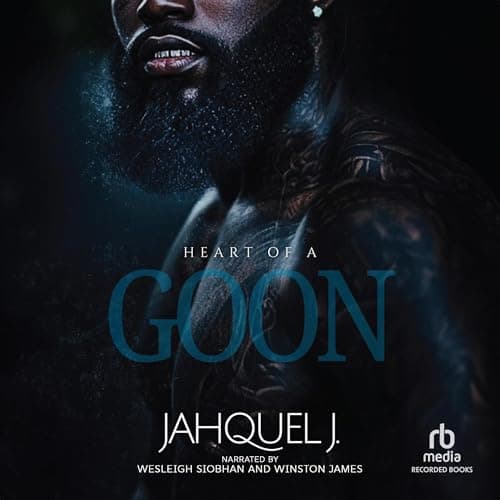
Wesleigh Siobhan and Winston James split the narration along character lines, and the effect is pretty much what you'd want from a dual-narrator romance — you get dropped into each headspace fully. Siobhan carries Zoya's guarded delivery, that flatness that isn't monotone but chosen, the way someone who's decided not to feel sounds when they're narrating their own life. Winston James brings warmth and swagger to Goon's sections, and there's this contrast that mirrors the central dynamic of the book itself.
I don't have enough specific production notes to tell you whether the transitions are always clean or if there are any audio hiccups — my research came up light on technical details, and I won't fake it. What I can tell you is that at 12 and a half hours, the pacing felt right for a romance that's also dealing with family trauma, street violence, and the Caselli family dynamics. It doesn't rush. It doesn't drag. (And yes, I listened at 1.0x. The author chose those words.)
When the Classroom Meets the Lakefront
Here's what I kept coming back to on my walk with Denise that evening, earbuds still in, Goon's voice in my head talking about "coming for that heart, love, marriage, and those chocolate babies" — this book does something my students instinctively understand but literary culture often ignores. It takes Black love seriously as a subject worthy of extended, detailed attention. Not as backdrop. Not as subplot. As the whole architecture.
Is it going to win a National Book Award? No. Does it need to? Also no. Jahquel J. is doing specific, intentional work for a specific audience, and she's doing it well. The prose is direct, sometimes raw, and unapologetically vernacular. If you need your romance filtered through drawing rooms and euphemism, this isn't for you. But if you understand that "Word to Sharon" is a man swearing on his mother — staking his entire emotional credibility on his intentions — then you get what this book is after.
I keep telling my students that the best stories make you feel something you didn't plan to feel. That same unplanned gut-punch caught me with Immortal Dark — another book I picked up as homework and finished feeling like I'd been ambushed by something real. I planned to listen to this as research, as cultural expansion, as homework. Instead I found myself genuinely invested in whether Zoya Caselli could learn to stop being dead. And that's not nothing.
Who Should Listen (And Who Should Skip)
If you love romance that doesn't flinch — that treats street life and tenderness as parts of the same whole — queue this up. If you're a literary-fiction reader curious about urban romance but worried it won't have emotional depth, this is your bridge. Skip it if you need polished prose and drawing-room manners; Jahquel J. writes raw, vernacular, and direct, and she's not apologizing for it.
The Annotation in the Margin
This is why we still read — or listen to — stories outside our comfort zones. Not because they're "good for us" like literary vegetables, but because sometimes a book written for someone else's heart accidentally finds a door into yours. Jahquel J. found mine around hour seven, and I'm still thinking about it during faculty meetings. Which, to be fair, doesn't narrow it down much.