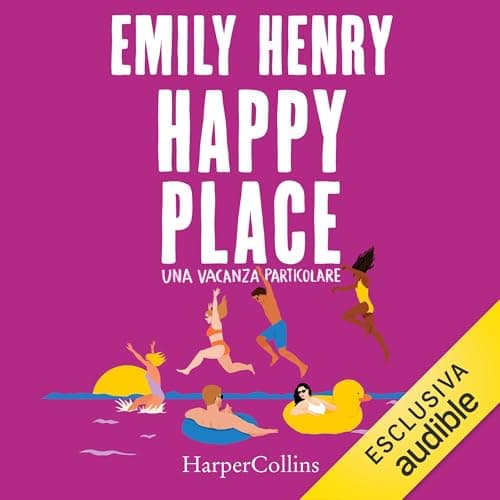

How many times can you break up with someone before you admit you never really let them go?
I was two hours into this audiobook, rearranging a client's brand palette for the third time at 1 AM — Frida curled on my keyboard, Diego batting at my stylus — when Harriet described the specific way Wyn still reaches for her hand out of habit, even months after the breakup. And I had to pause. Set down my coffee. Stare at the ceiling for a minute. Because Emily Henry just gets that thing about muscle memory in love, how your body refuses to catch up with the decision your brain already made.
This is the Italian edition narrated by Elena Fiorenza, and I want to be upfront: my research on her specific performance is thin. I can't point you to a catalogue of vocal quirks or accent shifts. What I can tell you is that twelve and a half hours in Italian with a single narrator on a story this emotionally layered is a commitment — and the fact that I listened at my usual 1.0x without once reaching for the speed toggle tells you something. The Italian translation by Tessa Bernardi gives the dialogue a warmth that felt almost telenovela-adjacent to me (Abuela would have loved this one, the fake-dating-your-ex setup is peak novela energy, and I could practically hear her muttering "¡Ay, dile la verdad!" at Harriet through the screen).
The Cottage That Holds Everything They Won't Say
The genius of Happy Place isn't the "pretend we're still together" premise — that's been done. It's that Henry traps these two people in a Maine cottage surrounded by friends who know them too well, and the tension isn't "will they get caught?" so much as "what broke them in the first place?" The story toggles between present-day vacation and college-era flashbacks, and those flashbacks hit different in audio because you can't skim them. You sit in young Harriet's insecurity. You marinate in the early Wyn moments where he's all easy charm and then suddenly says something so raw it knocks the wind out of you.
Harriet's arc specifically wrecked me — the way she buries her real self under "the specializzanda in chirurgia who never fights," performing competence and calm while she's drowning. As someone who spent years performing "successful designer" while secretly terrified I'd made a mistake dropping out of art school, that specific flavor of self-erasure in a relationship? It felt like getting called out by a friend who's too perceptive for your comfort. That same reckoning with self-erasure and the stories we tell ourselves to keep going — I sat with something similar while reading The Subtle Art of Not Giving a F*ck, which landed on my spreadsheet for entirely different reasons but left the same uncomfortable fingerprints.
When the Humor Cracks and the Real Thing Bleeds Through
Emily Henry's signature move is comedy that dissolves into gut-punch honesty, and she pulls it off here with surgical precision (pun intended, given Harriet's career). There's a scene — I think it's around the midpoint — where the friend group is playing some chaotic party game and Harriet and Wyn's fake-couple act starts glitching. The laughter in the room goes brittle. In audio, that shift lands harder because Elena Fiorenza's pacing slows just enough that you feel the room temperature change.
I ugly-cried twice. Once during a confrontation between Harriet and Wyn that finally cracks open why they actually split (and it's not what you think — it's quieter and sadder than you expect). And once during a scene near the end involving the friend group that I won't spoil but — my heart. MY HEART. The vibes are immaculate in the beach-house-with-friends way, but underneath that there's this ache about growing up and growing apart and choosing to stay anyway.
Compared to Beach Read, which I still hold as my four-cry champion, Happy Place trades some of that book's literary-world specificity for a broader emotional canvas about identity and people-pleasing. It's warmer but slightly less sharp. And compared to Funny Story, I think Happy Place has more emotional weight but a slower burn — the dual timeline means you're investing in two versions of the same relationship simultaneously.
Who Gets the Key to This Cottage (And Who Should Skip)
Pick this up if you want a romance that earns its happy ending through actual emotional reckoning, not just plot mechanics. If you're a sucker for found-family friend-group energy layered over a second-chance love story, this is your book. Skip it if you need constant forward momentum — the flashback structure means you're building two stories at once, and if you're listening while distracted, you'll lose the thread.
The Italian edition adds a layer I wasn't expecting: romance in Italian just sounds different, more operatic, more permission to feel big feelings. I can't give Elena Fiorenza a precise rating because I don't have enough comparison points for her other work, but she carried twelve-plus hours without losing me, and for a book this dependent on emotional subtlety, that's not nothing.
The Spreadsheet Entry
Two cries. Adding it to the spreadsheet. This book felt like finding an old photo of someone you loved tucked inside a book you forgot you owned — that specific sting of remembering who you were when you were happiest. Not Emily Henry's sharpest, but maybe her most tender.