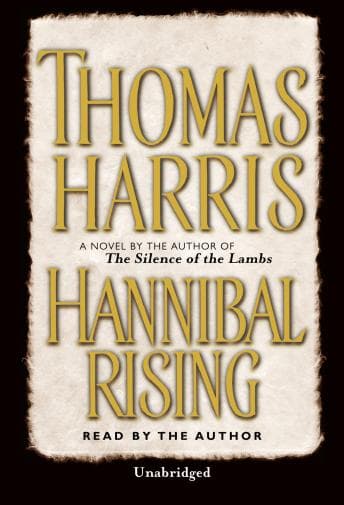

Thomas Harris reading his own book about Hannibal Lecter's origin story. That's either a gift or a curse, and honestly? It's both.
I finished this one on my drive home after a particularly brutal shift - three traumas back to back, the kind of night where you question every life choice that led you to medicine. And here I am, listening to the origin story of a cannibal. My decompression choices are questionable, I know. Carlos has stopped asking.
The Author in Your Ear
Here's the thing about Harris narrating his own work - the man has this deep Southern drawl that sounds like bourbon and old libraries. When he shifts into German or French accents for the European characters, it actually works. Like, genuinely works. Lady Murasaki's scenes have this different texture because of how he approaches her dialogue.
But - and this is a big but - he's not an actor. There are stretches where the narration goes flat, where you can tell he's reading rather than performing. I caught myself drifting during some of the wartime sequences, and I'm someone who can chart while listening to true crime podcasts.
Some listeners hate author-narrated books on principle. I get it. There's a reason audiobook narrators train for years. But there's also something unsettling about hearing the creator of Hannibal Lecter guide you through his monster's childhood. Harris knows exactly how much darkness he put on those pages. When he reads it, you feel that.
Young Hannibal, or Why This Book Frustrates Me
Look, I've consumed everything Hannibal-related. Red Dragon. Silence of the Lambs. The whole catalog. This one hits different, and not always in a good way. The first half drags through Eastern Front horrors - which, yes, explains how a boy becomes a monster, but the pacing made me check my phone at red lights more than once. That's not great for a seven-hour audiobook.
The medical school sections though? Finally, something I can sink my teeth into. (Sorry. Had to.) Harris gets the obsessive precision of someone learning anatomy, the way understanding the human body can become something else entirely. As someone who's actually worked a code, who's seen what bodies can endure and what they can't - the clinical detail here felt right. Not overdone. Not Hollywood-ized. Just cold and accurate.
But here's my problem: I wanted more of adult Hannibal becoming Hannibal, less of traumatized child surviving war. The revenge arc with Lady Murasaki's help is compelling when it finally kicks in, but you have to wade through a lot of setup to get there.
Night Shift Approved? With Caveats
This is not a multitasking audiobook. I tried listening while doing charting one slow night and completely lost the thread. Harris's subtle approach means you miss things if you're not paying attention. For my 3 AM quiet moments when the unit is actually calm (knock on wood, always knock on wood), it worked. For driving home exhausted? Less ideal. I had to rewind more than once.
The seven-hour runtime feels about right for the story, though I'd argue it could've been tighter. Some of those wartime sequences could've been trimmed without losing impact.
Who Should Press Play (And Who Should Keep Scrolling)
If you're a Hannibal completionist who needs to understand where the monster came from, this is required listening. If you specifically want to hear Thomas Harris's voice shaping his creation, the author narration is a feature, not a bug. The German and French accents genuinely add something.
But if you're coming in expecting Silence of the Lambs energy? Adjust those expectations. This is slower, more psychological, and frankly less satisfying than the earlier books. I got that same psychological slow-burn feeling from Nine Perfect Strangers, where the tension builds through character study rather than action. If you need a dynamic narrator who gives each character a distinct voice, you'll find Harris's approach too subtle. Some listeners called it average. I'd say it's more... restrained. Whether that works for you depends on what you want from an audiobook.
Clocking Out
I didn't yell at my dashboard during this one. That's either a compliment to the medical accuracy or an admission that there wasn't enough medicine to critique. Probably both. It's a solid origin story that explains too much and leaves you wanting different things than it delivers. Harris's narration is an acquired taste - like night shift coffee, it's not for everyone, but those who get it, get it.
Carlos asked why I looked so thoughtful when I came in that morning. I told him I was thinking about childhood trauma and the making of monsters. He handed me coffee and didn't ask follow-up questions. Fifteen years of marriage to a trauma nurse will do that.