
What does it actually look like when a country tears itself apart - not from the general's tent or the journalist's hotel bar, but from the kitchen table where a family is rationing garri and hoping the shelling stops before dawn?
That's the question that kept me pinned to this audiobook across three days of client site visits around San Antonio. I'll be honest - I picked this up because I realized my reading list was heavy on Western military history and light on pretty much everything else. Linda pointed that out. She wasn't wrong.
When War Arrives Through the Back Door
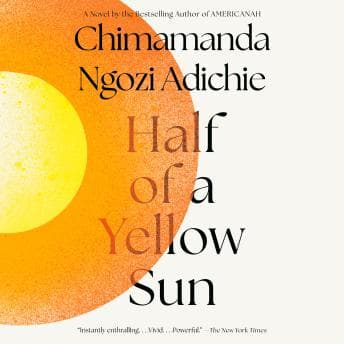
Let me cut to the chase: Half of a Yellow Sun is not a war book in the way I usually consume war books. There are no detailed tactical breakdowns of the Nigerian advance on Nsukka, no play-by-play of the Biafran resistance. And that's exactly what makes it devastating. Adichie builds this world of university intellectuals in 1960s Nigeria - Odenigbo hosting revolutionary salon discussions in his living room, his houseboy Ugwu learning to make pepper soup and discovering books for the first time - and she lets you live in it long enough to care. Really care. Then she methodically destroys it.
The Biafran War killed somewhere between one and three million people, most from starvation. I've seen what famine does to a population up close during my deployments, and Adichie doesn't flinch from it. The shift from Odenigbo's comfortable academic life to scenes of desperate refugees trading sex for food, children with kwashiorkor bellies - that trajectory hit me harder than most thriller climaxes I've listened to this year. Because she earned it. She spent hours building these people into real humans before she put them through hell.
I've seen this scenario play out in real life - how fast a stable society can unravel into ethnic violence when the political framework cracks. The Igbo massacres in the North that triggered Biafra's secession felt uncomfortably familiar to anyone who's watched sectarian killing unfold in Baghdad or Kabul. Different continent, different decade, same human ugliness.
Zainab Jah and the 18-Hour Commitment
Here's where I need to give you an honest debrief on the audio experience. Zainab Jah does solid work differentiating the characters - her voice for Ugwu carries this earnest, slightly uncertain quality that's distinct from the confident warmth she gives Olanna, and she shifts convincingly when voicing Richard, the English outsider who never quite belongs. The way she weaves between English and Igbo phrases feels natural rather than performative, which matters in a book where language itself signals belonging and alienation.
But - and this is a real but - 18 hours at her gentle pacing is a commitment. I bumped it to 1.25x early on and left it there. At normal speed, certain passages in the first half drift toward contemplative in a way that made my attention wander during highway driving. This is not a multitasking audiobook. When the war sections hit, I actually needed to be parked or sitting still because the emotional weight demanded full attention.
Some folks have noted that Jah doesn't fully capture Adichie's narrative voice - that the performance is softer than the prose demands. I can see that criticism. There are moments where the text is clearly furious and the delivery stays measured. Whether that's a flaw or an interpretation choice, I'll leave to you.
Five Characters, Zero Cartoons
What Adichie does with the character of Richard - the white Englishman writing about Igbo-Ukwu art who gets swept into the Biafran cause - is particularly smart. He's not a white savior. He's not a villain. He's a man who genuinely loves Kainene and genuinely cares about Biafra but can never fully escape being an outsider performing someone else's tragedy. His attempts to write "The Book" about the war keep failing because the story isn't his to tell. That's a level of self-awareness from Adichie that I respect.
And Ugwu's arc from wide-eyed houseboy to - well, I won't spoil it, but his trajectory includes a scene that's deeply uncomfortable precisely because Adichie refuses to let any character remain purely sympathetic. War doesn't just happen to people. It changes what they're capable of. I've watched young soldiers do things their mothers wouldn't recognize. Adichie understands that. That same stripping away of innocence under impossible pressure is something Golding got at too - Lord of the Flies works on a smaller stage but lands in the same dark place about what civilization actually costs.
Who Needs This in Their Ears
If you only listen to audiobooks during workouts or while mowing the lawn, skip this one. It'll punish you for not paying attention. But if you've got a long drive or dedicated listening time and you want to understand a war that most Americans have never heard of through the eyes of people actually living it - this is the real deal. Military history readers who want the human cost rather than the strategic overview will find something genuine here.
Worth your time? Here's the debrief: it's a slow build that pays off with emotional devastation, performed by a narrator who's good but not transcendent. The author clearly did their homework - this feels lived-in and true. Ranger sat through the whole thing without complaint, though he did give me a concerned look during a few of the harder chapters. Smart dog.
Mission accomplished, Adichie. Even if it took 18 hours to get there.