
Everyone talks about Stephen King's novels — the doorstoppers, the epics, the ones that became movies your college roommate won't shut up about. But I've always thought King's short fiction is where you really see the psychological machinery running. No room to hide behind subplot. No space for filler. Just a character, a situation, and whatever awful thing is about to happen to them.
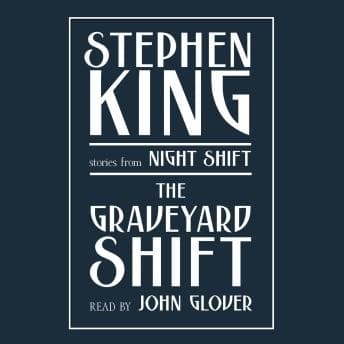
So when I found this audiobook — a curated selection from Night Shift clocking in at a tight three and a half hours — I figured it'd be perfect company while I was making chana masala on a Sunday evening. Alone in the kitchen, rain against the windows, John Glover in my earbuds telling me about rats. Good times.
The Psychology of Short-Form Horror (Or: Why These Stories Still Work)
Here's what I found myself asking: why does King keep returning to ordinary people in mundane jobs who encounter something monstrous? The title story, "Graveyard Shift," is literally about guys cleaning out a textile mill basement. That's it. That's the premise. And yet the protagonist exhibits classic avoidance behavior — he knows something is wrong down there, the rats are too big, the air is too wrong, but he keeps going because the alternative is admitting he's afraid. King understands that most horror isn't about the monster. It's about the human decision to walk toward the thing you should be running from.
"The Man Who Loved Flowers" is the one that got under my skin, though. The setup is almost romantic — a young man buying flowers on a beautiful spring evening, strangers smiling at him because he's so clearly in love. And then King pulls the rug out. The research actually shows that our brains process kindness and threat through overlapping neural pathways, and this story exploits that overlap with surgical precision. You feel warmth and then revulsion, and the transition happens in maybe three sentences. Psychologically, it's a masterclass in how we project our assumptions onto strangers. My therapist would have thoughts about this character. Many thoughts.
"Jerusalem's Lot" is the odd one out — epistolary, gothic, more Lovecraft than King. It's a fascinating case study in how format shapes psychological tension. Letters and diary entries mean the narrator survived long enough to write things down... or did they? The ambiguity does real work here.
John Glover vs. The Sound Effects Department
Now. John Glover. People online seem split on this recording, and I get why, because there are essentially two different listening experiences fighting for dominance in these three hours.
Glover himself? Pretty much exactly what you want for King's blue-collar horror. His voice has this slightly worn quality — not polished, not theatrical, but the kind of voice that sounds like it's telling you something it maybe shouldn't. When he shifts into the mill workers in "Graveyard Shift," you can hear the exhaustion and bravado. When he does the narrator of "The Man Who Loved Flowers," there's this unsettling warmth that makes the story's reveal hit harder because he never telegraphs it with vocal menace. That restraint? That's craft.
But then there are the ambient sound effects. And look — I understand the impulse. You want atmosphere. You want immersion. But when the background audio gets loud enough that you're straining to hear the actual narration over what sounds like someone left a haunted house sound machine running at full volume, you've lost the plot. There were moments — particularly in the basement sequences of "Graveyard Shift" — where the scuttling and dripping sounds competed directly with Glover's voice. I actually had to stop stirring my chana masala and rewind twice. Twice! For a three-hour audiobook!
Compared to other King narrations I've listened to — Will Patton's work on the Bill Hodges trilogy, for instance — this production makes a choice that Patton's recordings wisely avoid. Patton trusts his own voice to create atmosphere. This production doesn't always trust Glover, which is ironic, because Glover is the best thing about it.
Who Gets the Most Out of This (And Who Should Steer Clear)
If you're a King completist or you've never read Night Shift, this is a solid entry point — short enough to finish in an afternoon, psychologically sharp, and Glover's narration genuinely elevates the material when the sound design isn't stepping on it. Focused listening is key here. This is not a background-while-you-do-dishes situation (trust me, I tried). You need to pay attention or you'll miss the quiet moments where King does his best character work.
If you're someone who hates added sound effects in audiobooks — and I respect that position — be warned. It's not constant, but it's noticeable enough to pull you out of stories that depend on subtlety.
Also worth noting: this is only a selection from Night Shift, not the full collection. If you're expecting all the stories, you'll be disappointed. And the fact that the full collection was split across multiple audiobooks requiring separate credits? That's not a creative decision. That's a business decision. And it's annoying. It reminded me of how Eragon was carved up and marketed across multiple volumes in ways that felt more like franchise-building than storytelling — the reader pays the price either way.
My Case Notes
Three and a half hours of Stephen King's short fiction read by someone who actually understands pacing and character voice, slightly undermined by a production team that didn't know when to leave well enough alone. The stories themselves hold up — King's early work has a lean, mean quality that his later novels sometimes lack. "The Man Who Loved Flowers" alone is worth the listen for anyone interested in how narrative structure can weaponize reader empathy.
Would I recommend it? Yes, with caveats. Glover is excellent. The stories are psychologically honest. But turn it up loud enough to hear past the sound effects, and maybe don't try to cook while you listen.