
I was sitting in the back pew of St. Hyacinth's last Sunday — Denise drags me to Mass maybe once a month, and I go because marriage is about strategic concessions — when Father Kowalski read from John's prologue. "In the beginning was the Word, and the Word was with God, and the Word was God." And I thought: I've heard that sentence a thousand times. I've taught the concept of logos in Western Lit. I've referenced it in my podcast episode on Milton. But do I actually understand what John was doing with that opening? Honestly? No. Not really.
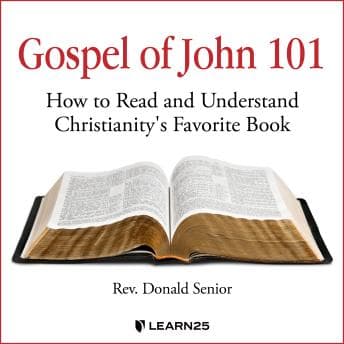
So I downloaded Donald Senior's Gospel of John 101 that afternoon and spent the next week listening during my grading marathons. And here's what I'll say: this is not an audiobook in the traditional sense. It's a lecture series. A classroom. And Senior is the kind of professor you wish you'd had in college — the one who makes you feel smart for asking questions you were embarrassed to ask.
The Professor You Didn't Know You Needed
Donald Senior isn't a narrator. He's a teacher who happens to be recorded. There's a difference, and it matters. He doesn't perform the Gospel of John — he unpacks it. His delivery is measured, almost conversational, like a man who's spent fifty years thinking about these texts and has arrived at a place of calm authority rather than dramatic urgency. No theatrical voices for Jesus or Nicodemus. No swelling music. Just a scholar sitting with you, walking through the text passage by passage.
What struck me immediately is how Senior handles the relationship between John and the synoptic Gospels — Matthew, Mark, Luke. He doesn't just note the differences (no birth narrative, no Sermon on the Mount, no parables in the traditional sense). He explains why John's community made different literary and theological choices. The Fourth Gospel, Senior argues, is doing something fundamentally different with narrative time. Where the synoptics build toward the crucifixion as climax, John's Jesus seems to exist in a kind of eternal present — the "I AM" statements aren't just theological claims, they're structural choices that reshape how the story moves.
This is why we still read the classics, by the way. Even sacred ones. Especially sacred ones. Because the form is the theology.
When a Scholar Reads Like a Scholar (And That's Okay)
Let's talk about what Senior is really saying about the Prologue — those first eighteen verses that most people know fragments of but rarely sit with as a complete literary unit. Senior spends considerable time connecting John's logos concept to both Greek philosophical tradition and Jewish Wisdom literature, particularly Proverbs 8 and Sirach 24. He's not showing off. He's showing you the intellectual world John's community was swimming in. The Gospel didn't emerge from a vacuum. It emerged from a community wrestling with how to articulate something that broke their existing categories.
At 4 hours and 52 minutes, this is compact. Almost too compact. Senior covers the entire Gospel — the Book of Signs, the Book of Glory, the Farewell Discourse, the Beloved Disciple's identity — and sometimes you feel him compressing material that could easily fill a semester course. The section on John 9 (the man born blind) felt rushed to me, which is a shame because that's one of the most brilliantly constructed narratives in the entire Bible — a story where the blind man progressively "sees" while the Pharisees progressively go blind. Senior touches on this irony but moves on before it fully lands.
His voice itself is clear and unhurried. No pronunciation stumbles that I caught. But — and I say this with affection for a fellow educator — there's a flatness that settles in around hour three. The energy doesn't vary much. When he's discussing the raising of Lazarus, a passage absolutely loaded with dramatic and emotional weight, his tone is roughly the same as when he's laying out structural parallels between John and the Qumran community. My students would call this "lecture voice." They're not wrong.
Who Should Sit in This Classroom
If you're looking for spiritual devotion or emotional inspiration, this probably isn't your entry point. Senior is an academic first. A warm one, a believing one, but an academic. This is for listeners who want to understand how John's Gospel works — its literary architecture, its theological vocabulary, its historical context. If you loved Raymond Brown's scholarship but wanted it in audio form with a gentler learning curve, this is its spiritual successor. That same hunger for serious engagement with faith — not devotional hand-holding, but genuine intellectual wrestling — is exactly what drew me to Pursuit of God, which I reviewed a while back and still think about more than I expected to.
The included PDF study guide is a genuine asset — I printed mine and found myself scribbling notes in the margins like I was back in grad school. (Denise found me at midnight with highlighters spread across the kitchen table and just shook her head.)
Non-Christians or readers approaching this as literature rather than scripture will still find value here, though Senior writes and speaks from within the Catholic tradition without apology. He assumes faith. He doesn't argue for it.
Worth Pausing the Faculty Meeting For
At under five hours, this is a focused, intelligent walk through Christianity's most philosophically ambitious Gospel, guided by someone who clearly loves the text and has given his life to understanding it. The narration won't win awards for performance — but that's not the point. The point is the teaching. And the teaching is solid.
I listened to the final section — Senior's reflection on the epilogue in John 21, that strange beach breakfast with the risen Jesus — while walking the lakefront at dawn. The lake was doing that thing where it looks like hammered silver. And Senior was talking about how John ends not with cosmic triumph but with a quiet, personal question: "Do you love me?" Asked three times. Once for each denial.
The prose deserves to be savored. Even — especially — when it's two thousand years old and someone finally helps you hear it properly.