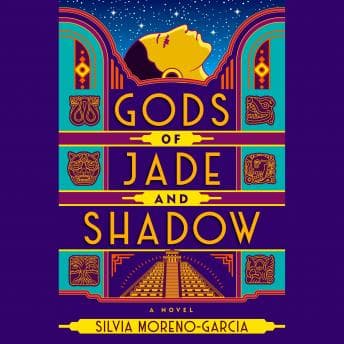

I was three hours deep into a board game solo campaign — Gloomhaven, if you must know — when I realized I'd completely stopped moving my miniatures and was just sitting there with my hand on a damage modifier card, staring at nothing, listening to Casiopea Tun argue with a literal death god about bus fare. That's when I knew this book had me.
Silvia Moreno-Garcia does something here that I genuinely respect as someone who spends way too much time thinking about magic systems and world-building: she takes Mayan mythology — specifically the lords of Xibalba and the death god Hun-Kamé — and slots it into 1920s Jazz Age Mexico like it was always supposed to be there. This isn't some Wikipedia-entry approach to mythology where gods just show up and monologue about their powers. The divine and the mundane bleed into each other. Hun-Kamé is losing his godhood piece by piece because Casiopea accidentally absorbed a bone shard from his skeleton when she opened that box, and that slow exchange — him becoming more human, her becoming more... other — is the engine that drives everything. The progression is satisfying. Like watching a dual stat block where one character's abilities drain while the other's fill up. My D&D group would love this as a campaign premise. Speaking of campaigns built around godlike power changing hands, Confessor scratches a similar itch if you want that same feeling of watching a carefully constructed magical order start to crack at the seams — though Goodkind's execution is considerably messier than what Moreno-Garcia pulls off here.
Xibalba's Road Map Hits Different Than Asgard's
Look, I'm a Sanderson guy. I like hard magic systems with rules and consequences. What Moreno-Garcia does here is softer — more mythic, more folkloric — but it still has internal logic that I can respect. The Mayan underworld isn't just "spooky death place." There are specific roads, specific lords with specific domains, and the power struggles between Hun-Kamé and his brother Vucub-Kamé follow their own political rules. The way the journey takes Casiopea from dusty Uukumil through actual 1920s Mexican cities — Mérida, Veracruz, Mexico City, even up to El Paso — while simultaneously moving through layers of mythological geography? This is Sanderson-level world-building, just wearing a completely different skin. The Jazz Age setting isn't window dressing either. There's a scene in a Mexico City jazz club where the collision of modernity and ancient divine power actually means something thematically — Casiopea is caught between the old world her grandfather represents and the new world she desperately wants.
The fairy tale structure is deliberate and announced — Moreno-Garcia literally has a narrator voice that occasionally steps back and comments on the story's shape, almost like a storyteller around a fire. If you don't like info-dumps, this isn't for you (but you're wrong). The prose is lush. Almost too lush for audio, actually, which brings me to the part I need to be honest about.
The Narration Problem (And It Is a Problem)
Yetta Gottesman's performance is... uneven. I want to be fair here because the material is genuinely challenging — you've got Mayan gods, Mexican Spanish names, 1920s slang, and a narrative voice that shifts between intimate and omniscient. But there are stretches where the reading feels flat, like someone sight-reading aloud rather than performing. The inflection lands in weird places sometimes, and distinguishing between characters in dialogue-heavy scenes requires more concentration than it should. Hun-Kamé and Casiopea's conversations — which should crackle with that slow-burn tension between a god losing his divinity and a mortal gaining power she never asked for — sometimes just... lay there.
It gets better as the book goes on. By the back half, there's more energy, more humor in the delivery. But those first few hours tested my patience, and I say that as someone who regularly commits to 40-hour Stormlight books without blinking. Yes, it's only 11 hours. But when the narration isn't pulling its weight, 11 hours can feel longer than it should.
Who Gets an Invite to This Table
If you're the kind of fantasy reader who's tired of European-flavored settings and wants mythology that isn't Norse or Greek — absolutely grab this. If you love the fairy-tale-retelling energy of books like Uprooted or Spinning Silver but want something rooted in Mesoamerican tradition instead of Eastern European, this is your next listen. The slow-burn romance between Casiopea and Hun-Kamé has a Beauty-and-the-Beast quality that works precisely because neither of them stays what they started as.
But if you need your narrator to carry the emotional weight — if voice performance is what makes or breaks your audiobook experience — honestly consider reading this one in print instead. The prose deserves better than what the audio delivers in its weaker moments. I read this instead of writing my thesis, and I don't regret the story one bit. I just wish the performance had matched the material.
Roll for Recommendation
The book itself? Easy 4-star territory. Beautiful mythology, a protagonist with actual agency and desire beyond just surviving, and a setting I want to see way more of in fantasy. The audiobook specifically? The narration pulls it down enough that I can't tell you to spend a credit on it with full confidence. Borrow it, stream it, see if it clicks for you — but keep the print version in your back pocket if the audio isn't landing. The magic system is chef's kiss. The delivery is more like a polite nod.









