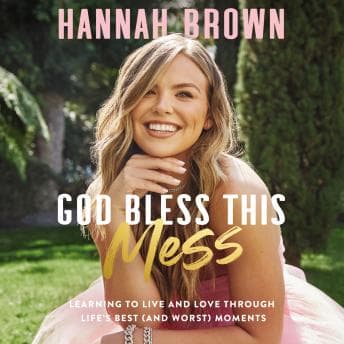

Okay, I need to talk about something that's been bugging me since I finished this book: why does Hannah Brown apologize so much? Like, girl, this is YOUR memoir. You don't have to justify every single feeling you had at twenty-four. But also - and this is the thing that got me - that constant apologizing is exactly what the book is about. The need for approval. The performing. The pageant smile plastered on while everything inside is falling apart. And once I realized that, the whole listening experience shifted.
I pressed play on this one during a late-night design session - I was building brand assets for a wellness startup, which honestly felt cosmically appropriate given how much Hannah talks about therapy and journaling saving her life. Frida was asleep on my lap, Diego was doing that thing where he stares at the wall like he's receiving transmissions. And Hannah Brown was in my ears, talking about depression during her pageant years with this rawness that made me stop mid-kerning adjustment and just... sit there.
The Southern Girl Who Stopped Smiling on Command
Here's what surprised me: I went in expecting Bachelor-franchise tea. And there IS some of that - the behind-the-scenes Bachelorette stuff, the Dancing with the Stars chapters. But the parts that hit hardest are the ones about her family. There are heartbreaking family stories in here that have nothing to do with reality TV, and Hannah delivers them with this quiet, almost reluctant vulnerability. Like she's telling you something she hasn't fully processed yet. Her voice gets softer in those moments, that Southern charm pulling back to reveal something genuinely wounded underneath.
And look, I was raised by a woman who believed suffering builds character and that God has a plan even when the plan feels cruel. So when Hannah talks about her faith being tested - really tested, not Instagram-caption tested - I felt that in my chest. The "And Jesus still loves me" moment from the show hits different when you hear the full context of what she was carrying. Abuela would have loved this one, honestly. She would've been nodding along like, "Sí, mija, that's how it works."
When the Narrator IS the Wound
Hannah narrates this herself, and I have complicated feelings about it. Her charming Southern accent is warm and easy to listen to - there's a genuineness there that a professional narrator couldn't replicate. When she's talking about moments of real pain, you can hear the emotion catch in her throat, and THAT is something no hired voice could give you. She's not performing vulnerability. She's just... vulnerable.
But. (There's always a but.) Some chapters are dry. There are stretches where the energy dips and she reads like she's going through the motions - particularly in the middle sections where she's recounting events more than feeling them. It's uneven. You get these gorgeous, gutting emotional peaks followed by valleys where I found myself adjusting my headphones wondering if I'd zoned out. I hadn't. The book just goes flat sometimes.
And yes, some moments feel disproportionate. Small things get elevated to crisis level in a way that - I'm sorry, I love you Hannah, but when you've lived through actual hardship, a twenty-four-year-old's quarter-life spiral can feel a little... much. I caught myself thinking "girl, THAT'S what broke you?" more than once. But then I'd remember being twenty-four and how everything felt like the end of the world, and I'd soften. That's her truth. She's allowed to have it.
Who Needs This in Their Ears (And Who Doesn't)
If you're a Hannah Brown fan, this is essential - you'll feel like she's sitting across from you at brunch, mascara slightly smudged, being the most real she's ever been. If you're a woman in your twenties figuring out whose expectations you've been living for, this book felt like a mirror held up at an uncomfortable angle. Not always flattering, but honest.
If you need polished, professional narration with perfect pacing? This isn't that. If you're looking for deep theological exploration of faith? Also not that. And if celebrity memoirs make you roll your eyes on principle, this won't convert you.
I cried once - just once, during the family stuff, not the TV stuff. Which tells you everything about where the real heart of this book lives. It's not in the rose ceremonies. It's in the living room in Alabama, with a girl trying to figure out if she's allowed to be sad when everyone keeps telling her she should be grateful.
My heart didn't shatter, but it ached. And sometimes that's enough.
The Messy Bookmark
This is a rainy Sunday book. Not a great audiobook, but a good one - carried more by honesty than craft. Hannah Brown at her most raw is worth your time. Hannah Brown going through the motions is forgettable. You get both here, and whether it's worth it depends on how much grace you're willing to extend to someone learning in public. I extended it. I don't regret it.