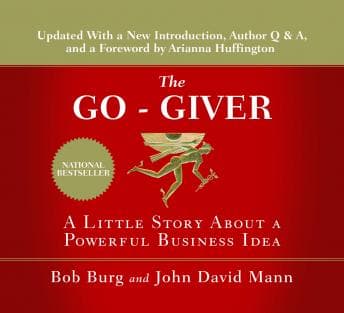

Look, I'm going to be upfront with you. When someone tells me the secret to business success is "giving," my first instinct is to check if they're trying to sell me essential oils. I've sat through enough McKinsey presentations to know that "give more" doesn't usually show up in the ROI projections.
But here's the thing about The Go-Giver—it's under three hours. That alone deserves respect. Most business books take 8 hours to tell you what could fit on a napkin. Burg and Mann? They got in, made their point, got out. My parents would appreciate that efficiency, even if they'd probably side-eye the whole "stratospheric success through generosity" premise.
So the setup: Joe is a go-getter (their words, not mine) who's desperate to close a deal. He meets Pindar, this legendary consultant who introduces him to a series of successful people who all attribute their success to giving. Five Laws of Stratospheric Success. It's a parable. You know the drill.
Now, here's where I surprised myself. I didn't hate it.
(Jenny would say I'm growing as a person. Jenny is being generous.)
Two Authors, One Smooth Listen
The authors narrate this themselves, and honestly? It works. Burg and Mann have these complementary voices—Burg's got this warm, almost fatherly energy, and Mann balances it out. The transitions between them flow naturally enough that you forget you're listening to two people. It feels less like an audiobook and more like two guys telling you a story over coffee. Clean production, good pacing, no dead air. Professional.
The Survivorship Bias Problem
Here's my issue though—and I've seen this pattern at probably a dozen startups I've consulted for. The "give first" philosophy works great when you're already successful. The restaurateur who gives away recipes? She's already got the restaurant. The CEO who focuses on adding value? He's already a CEO. It's easy to be generous when you're not worried about making rent.
My parents gave everything to that dry cleaning business. 14-hour days, perfect service, remembered every customer's name and their kids' names. They gave and gave and gave. Did they achieve "stratospheric success"? They achieved survival. They achieved putting two kids through college. That's its own kind of success, but it's not the TED talk version.
That said—and I'm being fair here—the Five Laws aren't actually bad. The Law of Value (your worth is determined by how much value you give beyond what you receive) is basically what every good salesperson already knows. The Law of Compensation (income determined by how many people you serve) is just scale. The Law of Influence (put others' interests first) is networking 101. This is what my parents did instinctively. The Surrender Experiment takes this "let go and trust" philosophy even further—though at least that one admits the privilege required to surrender in the first place. Now it has a TED talk.
The narration keeps you engaged even when the message gets a bit... preachy. And yeah, it gets preachy. There were moments where I was listening at 2.0x and still felt like I was being gently lectured by a very earnest uncle at Thanksgiving. But Burg's delivery has this genuine enthusiasm that makes it go down easier. He believes this stuff. You can hear it.
Who Gets Value Here (And Who Won't)
If you're early in your career and haven't been completely beaten down by corporate cynicism yet, there's value here. The reframing from "what can I get" to "what can I give" is genuinely useful mindset work. New salespeople, entrepreneurs who've been grinding too hard on the hustle—they'll probably get something out of it.
Skip if you're looking for actual strategy. This is philosophy, not tactics. If you want a business book that tells you HOW to do things, look elsewhere. This tells you how to THINK about things. Different animal. Also skip if you're allergic to parables. The whole "wise mentor introduces protagonist to series of successful people who share wisdom" format is... well, it's a format. Some people find it charming. Some people (me, sometimes) find it a bit forced.
The ROI Calculation
It's a quick listen that delivers exactly what it promises. No padding, no filler, genuine narration from authors who clearly care about their message. Is it going to revolutionize your business? Probably not. But at under three hours, the opportunity cost is low. The core message—focus on giving value rather than extracting it—isn't groundbreaking, but it's a decent reminder.
My 2.0x speed didn't need to save this one. It was already respecting my time.
Three and a half stars. Would've been higher if the examples felt less like successful people justifying why generosity worked for them after they'd already made it. But for what it is—a short, well-narrated business parable with a positive message—it does the job.