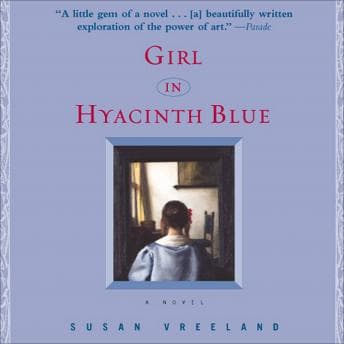

"A most extraordinary painting in which a young girl wearing a short blue smock over a rust-colored skirt sat in profile at a table by an open window."
I was grading sophomore essays on The Great Gatsby—the same tired observations about green lights I've read for two decades—when that opening description stopped me cold. Denise had already gone to bed, and I sat there at 11:47 PM with my red pen frozen mid-correction, completely arrested by the idea of a novel that moves backward through time, tracing a single Vermeer painting from present-day Pennsylvania to 17th-century Delft.
Susan Vreeland was a high school English teacher for thirty years. Thirty. And somehow she still had this left in her. That gives me hope, honestly.
The Provenance of Grief
What Vreeland understands—what my students don't yet, what I didn't at their age—is that objects carry weight. Not metaphorical weight. Real, accumulated human weight. Each chapter peels back another layer of ownership, and the genius is that we're moving backward, so every revelation recontextualizes what we've already heard.
The opening chapter hits hard: a schoolteacher (I felt seen) reveals he owns what he believes is an authentic Vermeer, inherited from his father. His father was a Nazi officer who looted it from Dutch Jews. That's not just backstory. That's the kind of moral complexity that makes you pause the audiobook and stare at the ceiling for a while.
By the time we reach the "Hyacinth Blues" segment—which several listeners cite as their favorite, and I understand why—we've watched this painting survive natural disaster, political upheaval, and the quiet devastation of personal loss. The painting endures. The people don't. This reminds me of what Hemingway said about writing: the dignity of movement of an iceberg is due to only one-eighth of it being above water. Vreeland shows us the eighth above water and trusts us to feel the mass beneath.
Three Voices, Uneven Brushstrokes
Here's where I have to be honest. The multi-narrator approach—Gigi Bermingham, J.D. Cullum, and Jennifer Baum trading sections—is ambitious but inconsistent. Some chapters land with genuine emotional weight. The narrators who bring what one listener called "character and sass" elevate their sections into something approaching performance art. The prose deserves to be savored, and when the narration matches that intention, it's genuinely moving.
But other sections feel... flatter. Not bad, exactly. Just less alive. It's like watching a museum tour where some docents love the work and others are reading from a script. You notice the difference. At five hours, this isn't a major commitment, but the unevenness does pull you out occasionally.
I listened at 1.0x because—and my students think I'm ancient for this—the author chose those words. Vreeland's sentences have a painterly quality themselves, "finely wrought, artfully illuminated," as the description says. Speeding through them would be like walking past a Vermeer to check your phone.
What Vermeer Knew (And What We Forget)
The final chapter, where we meet the girl in the painting herself, is devastating in the way only quiet revelations can be. No explosions. No dramatic confrontations. Just a young woman in Delft, sitting by a window, unaware that her image will outlive empires.
Vreeland stirs something I've felt less often lately—that long-buried desire to create rather than just consume. To leave something behind. My podcast has 47 listeners. My mom falls asleep during the Faulkner episodes. But maybe that's not the point. Maybe the point is the making.
Though I'll admit, on nights when I want something that keeps the pulse racing rather than the mind wandering, I've found myself on the opposite end of the spectrum—my review of One Killer Force is basically proof that I contain multitudes.(Denise found me still sitting there at 1 AM, essay pile untouched, just thinking about light through a window in 17th-century Holland. She asked if I was okay. I said I was thinking about permanence. She said that's very on-brand for me and went back to bed.)
Who Should Follow This Provenance
If you loved The Goldfinch or Girl with a Pearl Earring, this is their spiritual successor—quieter, more intimate, less sprawling. It's for readers who understand that art isn't decoration. It's witness.
Skip this if you need plot momentum. The structure is contemplative, moving backward through centuries with the patience of a museum conservator cleaning varnish from canvas. My students would hate this. I love it.
Worth Pausing the Faculty Meeting For
This is the kind of audiobook that rewards attention. Not background listening. Not half-focus during a commute. The emotive details in the narration—when it works—demand presence. You'll miss the connections between chapters if you're also thinking about budget presentations.
Vreeland wrote this while still teaching. Still grading. Still showing up for teenagers who probably didn't appreciate her. And she made something that will outlast all of us.
That's what Vermeer knew. That's what we forget.