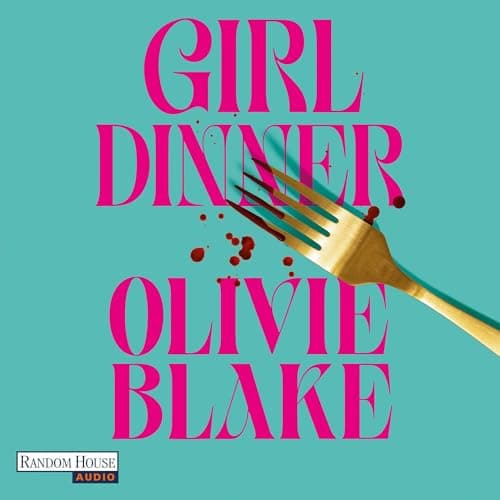

"Kosten, die mit Blut beglichen werden" — costs paid in blood. That line hit me around hour six, lying on my apartment floor after a twelve-hour shift, too wired to sleep but too exhausted to move. My prayer rug was still rolled out from Isha and I had Girl Dinner pumping through my earbuds like some kind of twisted lullaby. And honestly? This book understood something about hunger — literal and metaphorical — that most horror-adjacent fiction doesn't even attempt.
Let me back up. This is Olivie Blake's German-language audiobook adaptation (translated by Michael Siefener), and I went into it knowing her from The Atlas Six, which I respected for its ambition even when it frustrated me. Girl Dinner is a different animal entirely.
The Sorority That Eats Its Own
The premise is deceptively simple: Nina Kaur, a student desperate for belonging after a rough first semester, pledges "das Haus" — the most elite sorority on campus. Dr. Sloane Hartley, a postpartum professor struggling with her body, her absent-but-performatively-present husband, and the guilt of being separated from her baby, gets roped in as faculty advisor. Both women are starving for something — acceptance, control, identity — and the Haus promises to feed them.
Except the Haus feeds on them.
What got me was how Blake builds the horror not through jump scares or gore but through the slow, suffocating pressure of female perfectionism. The way she writes Sloane's post-baby body shame — clothes that don't fit, the husband who calls himself a "Girl-Dad" on Instagram while doing approximately nothing — I wanted to throw my phone. Not because it was badly written. Because it was so painfully accurate. As someone who's actually run a code at 3AM and then had an attending comment on whether I looked "tired," I felt that in my bones.
Nina's arc is different but equally sharp. She's a brown girl on a predominantly white campus who thinks assimilation equals safety. The Haus offers protection from men who see young women as prey. And for a while, it works. The sisters are beautiful, powerful, untouchable. But Blake keeps pulling the thread until you see the price tag, and it's written in flesh.
Dual Narration in German — What Works, What Doesn't
Demet Fey and Hannah Schepmann split the narration, and here's where I have to be honest: my research didn't turn up detailed performance breakdowns, and since this is the German-language version, I'm working with what I could gather. The dual narrator setup makes sense structurally — Nina and Sloane are in very different life stages with very different internal voices. Having two narrators prevents that flattening effect you get when one person tries to voice both a 19-year-old undergrad and a 30-something mom in crisis.
At 13 hours 20 minutes, the pacing is ambitious. Blake is not a minimalist — she wants you sitting in Sloane's spiraling thoughts, marinating in Nina's desperation. Between shifts and salah — this kept me going, but I'll admit there were stretches in the middle third where I bumped to 1.5x because the psychological tension plateaued before the blood-soaked payoff.
When Horror Respects the Weight of Bodies
Here's what elevated this for me: the body horror isn't gratuitous. It's thematic. Women's bodies are consumed — by beauty standards, by motherhood, by male entitlement, by institutions that promise empowerment while extracting compliance. The literal consumption in the Haus is just the metaphor made visceral. Medical accuracy matters. Lives depend on it. And while this isn't a medical thriller, Blake treats the body with a kind of clinical respect that I appreciate. She knows what hunger does. She knows what sacrifice looks like when it's carved from your own flesh.
That said — and this is where I have to push back — the feminist framework occasionally feels like it's doing too much explaining. Blake is smart. Her readers are smart. There were moments where the subtext was already doing the work and then a character would essentially say the thesis out loud. Trust us, sis. We get it.
Who Gets Fed, Who Gets Devoured
If you've ever felt the pull of a community that promises to make you better while slowly erasing who you are — sorority, workplace, even certain religious spaces (and yes, I've seen it) — this book will crawl under your skin. If you loved the sharp social commentary in Yellowjackets or the academic pressure-cooker energy of The Atlas Six, you'll find familiar ground here. The gothic atmosphere and institutional dread also reminded me of what Kerri Maniscalco does in Hunting Prince Dracula — that same sense of a woman navigating a system designed to consume her, except there the monster wears a castle instead of Greek letters.
But if you need your horror fast and bloody from page one, or if you're looking for a straightforward thriller with clear good guys and bad guys, this will test your patience. The horror is slow and social before it turns literal, and that's a deliberate choice that won't land for everyone.
The Prescription
I finished Girl Dinner at Fajr, staring at my ceiling, thinking about all the ways women are taught to shrink themselves to fit into spaces that were never built for them. My mom would be proud of this book — not because it's easy, but because it asks hard questions about what we sacrifice for belonging and whether the cost is worth the meal. Blake wrote something angry and smart and hungry. It's not perfect — the pacing dips, the thematic hand gets heavy — but it's the kind of book that stays with you like a meal you can't quite digest.