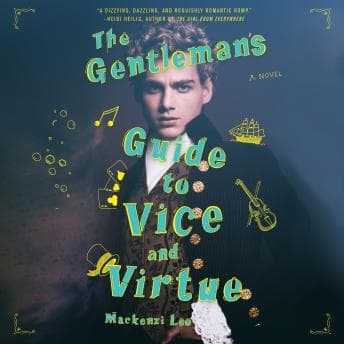

I was making dal makhani at 10 PM—the kind of elaborate cooking project I take on when I'm procrastinating on a research paper—when Monty Montague started narrating his disastrous life choices directly into my earbuds. By the time the lentils were simmering, I was completely hooked on this absolute disaster of a protagonist.
Here's what fascinated me: Monty exhibits classic self-sabotage patterns. He drinks too much, makes reckless decisions, and pushes away the person he loves most because he's convinced he doesn't deserve happiness. A genuine case study in internalized shame and its behavioral manifestations. Mackenzi Lee understands human nature—specifically, she understands that trauma doesn't make people noble. It makes them messy. Monty's father has beaten him down (literally and figuratively) until he's adopted a hedonistic persona as armor. The research actually shows that children of abusive parents often develop either hypervigilance or reckless risk-taking behaviors. Monty chose door number two.
When Your Best Friend Is Also Your Impossible Crush
The dynamic between Monty and Percy is where this book earns its psychological stripes. That tension between what society expects and what people actually need shows up differently in Voyeur, though admittedly with significantly less historical oppression and significantly more modern awkwardness. Percy is Black and epileptic in 18th-century Europe—a combination that means society has already decided his worth. What makes this character compelling is that Percy isn't written as a saint to balance Monty's chaos. He has his own quiet anger, his own wounds. Christian Coulson captures this beautifully—his voice for Percy carries this steady warmth with an undercurrent of something guarded. You can hear the exhaustion of someone who's spent his whole life being underestimated.
And then there's Felicity, Monty's younger sister, who Coulson voices with sharp intelligence that practically crackles. She wants to be a doctor. In the 1700s. As a woman. (My therapist would have thoughts about this character's coping mechanisms, specifically how she channels all her frustration into intellectual superiority. Relatable content.)
Coulson's Voice Work: Character Psychology Through Sound
Coulson's performance is genuinely impressive in how it differentiates emotional states. His Monty shifts between rakish bravado and genuine vulnerability—sometimes in the same sentence. The comedic timing on the witty banter had me laughing over my stovetop, and then he'd pivot to conveying longing so palpable I had to pause and stir my dal more aggressively than necessary.
I found myself asking: why does Monty's sarcasm sound different when he's scared versus when he's actually being funny? Coulson figured this out. The fear underneath the jokes comes through in tiny vocal catches, a slightly faster pace. It's subtle character work.
Now. The accents. His European accents do slip occasionally—I noticed it most with the French characters. Not egregiously, but enough that my brain registered the inconsistency. Minor complaint in an otherwise excellent performance, but if you're someone who gets pulled out of narratives by accent wobbles, fair warning.
What This Book Gets Right About Queer History
Lee doesn't sanitize the 18th century or pretend it was secretly progressive. Monty's bisexuality is treated as something that could genuinely destroy his life if the wrong people found out. Percy's blackness and disability mark him as "other" in ways the narrative doesn't shy away from. The book is funny—genuinely funny—but it doesn't use humor to avoid the harder truths.
Psychologically, this tracks. Historical fiction that pretends marginalized people didn't exist, or that they existed without consequence, does a disservice to everyone. Lee threads the needle of making this an adventure romp while acknowledging that her characters are navigating real dangers.
Who Should Clear 11 Hours For This (And Who Shouldn't)
If you want a protagonist who makes good decisions, skip this entirely. Monty will frustrate you. He frustrated me. But that's the point—watching someone slowly realize they might deserve love after all is the whole emotional arc.
Perfect for: anyone who loved Red, White & Royal Blue and wants a historical version; listeners who appreciate character-driven stories over plot-driven ones; people who enjoy watching disaster bisexuals eventually get their act together.
Skip if: you need fast-paced action (this is more adventure-adjacent than action-heavy); accent consistency is a dealbreaker; you're looking for something light for background listening—this requires attention.
The Prescription
I finished this audiobook around 1 AM, dal long since eaten, research paper still unwritten. Worth it. Coulson's performance elevates already strong material, and Monty's psychological journey from self-destruction to self-acceptance is the kind of character work I wish more YA attempted. The romantic tension between him and Percy builds beautifully—slow burn done right, where every loaded glance and almost-touch means something.
Is it perfect? No. The plot occasionally takes backseat to banter, and those accent slips are real. But when a book makes me want to diagram a character's defense mechanisms at midnight, it's done something right.