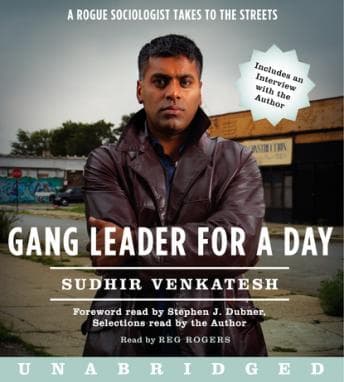

I went into this expecting a straightforward sociology study. Grad student embeds with gang, collects data, writes academic paper. The end. What I got instead was a seven-year case study in moral complexity that had me pausing my morning jog to just... stand there processing.
Sudhir Venkatesh walks into a Chicago housing project in 1989 with a clipboard and a multiple-choice survey about poverty. A multiple-choice survey. The research actually shows that this is approximately the worst possible approach to understanding lived experience, and Venkatesh figures that out real fast when he's held at gunpoint by gang members who think he might be a spy. What happens next—that he befriends the gang's leader JT and spends nearly a decade documenting life inside the Robert Taylor Homes—is either brilliant ethnography or ethical catastrophe. Probably both.
The Psychology of Unlikely Friendship
What makes this book compelling isn't the gang activity itself. It's the relationship between Venkatesh and JT. The protagonist exhibits classic observer-participant tension, constantly negotiating the line between researcher and friend, outsider and insider. JT is equally fascinating—ambitious, calculating, genuinely caring about his community in ways that don't fit neat categories. He runs a crack operation like a franchise business while also settling neighborhood disputes and providing informal welfare services.
I found myself asking: why does JT really let Venkatesh in? Power? Ego? Genuine connection? The book doesn't give easy answers, which is psychologically honest. Humans rarely act from single motives. JT wants his story told. He also wants validation. He also, I think, is genuinely lonely at the top of his particular hierarchy. Venkatesh wants groundbreaking research. He also craves the thrill. He also develops real affection for people he's technically studying.
My therapist would have thoughts about this dynamic. The power imbalances alone could fuel a semester's worth of discussion.
Reg Rogers Nails the Complexity
Reg Rogers handles the narration with exactly the right mix of distance and intimacy. He doesn't sensationalize the violence or poverty-porn the setting. JT's charisma comes through clearly, as do the women who actually run the buildings and the kids caught in impossible circumstances. There's a warmth to his reading that humanizes without sanitizing.
Stephen Dubner (of Freakonomics fame) contributes the introduction, which makes sense given that's how most people first heard about this research. But Rogers carries the bulk of the work, and he's good at it. Clear, authentic, emotionally present without being melodramatic.
One complaint I kept hearing about: there's this weird little musical flourish at the beginning of each chapter. I'll be honest, it didn't bother me much—I was usually too absorbed in what was happening—but I get why it irritated some listeners. It feels like a production choice from a different era of audiobooks. Minor gripe.
Where the Narrative Loses Steam
Here's my issue, and it's less about the audiobook than the book itself: the ending doesn't land. After seven years of immersion, the Robert Taylor Homes get demolished, the gang disperses, and Venkatesh... moves on with his academic career. The book just kind of stops. There's no climactic moment, no satisfying resolution. Which is realistic—life rarely provides neat endings—but it left me wanting more synthesis. More reflection on what it all meant.
Venkatesh also doesn't fully reckon with his own ethical compromises. He watched crimes happen. He accepted favors that implicated him in the gang's operations. He used people's trust to advance his career. The book acknowledges this discomfort but doesn't dig deep enough into it. I wanted more psychological honesty about his own motivations and guilt. Psychologically, this tracks with how we all rationalize our choices in the moment. But in a memoir, I expect more retrospective clarity.
Your Mileage May Vary
This is a fascinating case study in how communities survive under impossible conditions. If you're interested in urban poverty, organizational behavior (yes, gangs have org charts), or the ethics of participant observation, you'll find plenty to chew on. It's accessible without being dumbed down—Venkatesh writes like a storyteller, not an academic.
That same narrative accessibility shows up in Memoir of Jane Austen, though the subject matter couldn't be more different—both authors manage to make their subjects feel immediate and human without sacrificing complexity.
Skip it if you need tidy conclusions or if morally ambiguous content frustrates you. The language is harsh, the situations are grim, and nobody comes out looking entirely heroic. Including the author.
Case Closed (Sort Of)
I listened during a week of commutes and cooking sessions, and it held my attention throughout. Eight and a half hours felt about right—long enough to develop the relationships, short enough not to drag. Would I listen again? Probably not. But I'm glad I heard it once. Some stories you need to sit with, even when they don't resolve the way you want them to.









