I was halfway through a load of laundry when Poppy's world started falling apart in my earbuds, and I stood there holding a fitted sheet for a solid three minutes because I genuinely forgot what I was doing. That's the kind of hold this second half has on you once it gets rolling.
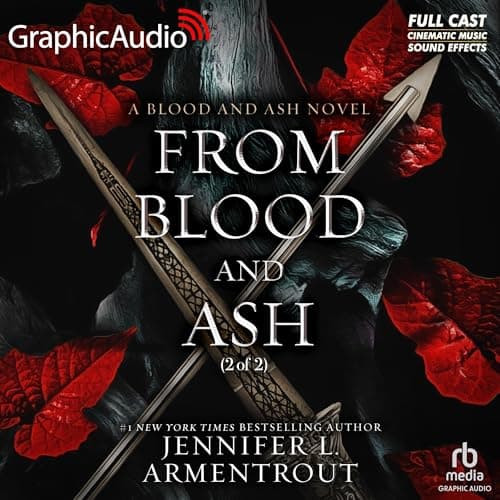
Armentrout has that gift across her catalog — Fall of Ruin and Wrath does something similar in its opening hours, that slow-tightening grip that sneaks up on you before you realize you've stopped doing whatever you were supposed to be doing.GraphicAudio's dramatized adaptation of From Blood and Ash Part 2 picks up where the first installment left off, and the back half of Armentrout's novel is where the story earns its reputation. Revelations cascade, loyalties fracture, and Poppy's understanding of everything she's been told gets systematically demolished. If Part 1 was the slow burn, Part 2 is the detonation — and hearing it performed by a full cast with cinematic scoring underneath gives those twists a visceral punch that a single narrator can't replicate.
Katie Boothe carries Poppy with exactly the right tension between vulnerability and steel. She's particularly effective during the moments where Poppy stops being the Maiden everyone expects and starts making choices that terrify the people around her. Stewart Crank's Hawke is the performance that's going to divide listeners. His jaunty British accent takes genuine adjustment, especially if you've spent hours with Stina Nielsen's original narration. I'll be honest — it threw me for the first twenty minutes. But once Crank settles into Hawke's teasing, provocative energy, the chemistry between him and Boothe during their charged scenes becomes the best argument for why this format exists. You can hear the tension in their delivery, the way dialogue that reads as flirtatious on the page becomes something that makes you hold your breath when it's performed. Dawn Ursula, Torian Brackett, and the rest of the supporting cast give Solis actual texture — it feels populated rather than described.
The production design deserves its own paragraph. Sword clashes during battle sequences have weight and space. Ambient crowd noise fills streets without drowning out dialogue. When the Craven draw close, the atmospheric sounds shift in ways that genuinely unsettle. The cinematic music cues are well-timed — they heighten emotional beats during the story's biggest turns without stepping on the performances. During the revelations in the final stretch, the scoring swelled underneath a conversation and I got actual chills on a Wednesday afternoon. From a book I'd already read. That's the production earning its keep.
Now, the trade-off you need to know about: this is abridged. Content has been cut. Internal monologue gets trimmed, world-building details are condensed, and some character moments that felt important in the original text simply aren't here. If you've read the novel and certain passages matter to you, you'll notice their absence. The dramatization compensates through performance and production for some of those losses, but it can't replace everything. There's also the pronunciation issue — names and locations don't always match how the original audiobook handled them. If you're coming straight from the standard version, that inconsistency pulls you out of the moment more than it should.
Compared to GraphicAudio's treatment of Fourth Wing, the production quality sits at a similar level, though I'd argue the romantic chemistry lands harder here because Boothe and Crank have such strong vocal contrast. Against the standard single-narrator audiobook of From Blood and Ash, you gain immersion and lose completeness. Whether that exchange works for you depends entirely on what you value — the full text or the cinematic experience.
At seven hours and eighteen minutes, the pacing stays taut. The abridgment actually helps in some ways — the second half of the original novel is already the faster, more intense portion, and trimming slower passages keeps the dramatization at a near-constant simmer. I never felt the urge to bump the speed up; the runtime earns every minute.
Who Should Listen (And Who Should Skip)
This is for you if you already enjoyed Part 1 of the dramatized adaptation, you don't mind abridgment, and you want chemistry and performance over textual completeness. The format genuinely elevates the action sequences and romantic tension in ways that justify its existence as more than just a novelty. Skip it if you need every paragraph of Armentrout's prose, if pronunciation inconsistencies between this and the original audiobook will drive you crazy, or if you're deeply attached to how Hawke sounds in your head and aren't willing to let someone else's interpretation override that. For everyone else who loved the book and wants to experience it through a different lens — this production delivers.