
This book is grief with no safety net.
I was three hours into a logo redesign for a client who keeps asking for "more energy" (sir, it's an accounting firm), Frida curled on my lap, Diego batting at my headphone cord, when Griffin started spiraling about Theo's death for the second time and I had to set my stylus down. Not because the moment was beautifully rendered - it was ugly. It was the kind of grief spiral where you watch someone make choices that hurt everyone around them, and you can't look away because you recognize the shape of it.
The Boy Who Wouldn't Let Go
So here's the setup: Griffin's ex-boyfriend Theo drowns. Theo had already moved on - new college, new boyfriend Jackson - but Griffin was still holding onto this fantasy that Theo would come back. And then Theo is just... gone. What makes Silvera's writing hit differently is that Griffin isn't a sympathetic griever. He's obsessive, he's selfish, he makes destructive choices that you want to shake him for. He calls Jackson, Theo's current boyfriend, and they bond over their shared loss, which sounds sweet until you realize Griffin is using that connection like a drug.
The Danish translation keeps Silvera's raw, almost clinical approach to depicting mental illness. Griffin's OCD and depression aren't quirky character traits - they're the engine driving him toward increasingly worse decisions. There's a scene where Griffin is cataloging his memories of Theo, trying to hold every detail, and it shifts from tender to suffocating so gradually you don't notice until you're uncomfortable. That's the whole book, really. Love curdling into something that traps you.
Jakob Femerling Andersen og den stille sorg
Here's where I'm conflicted. Some listeners have said they "didn't feel it" with the narration - and I get why. Femerling Andersen reads Griffin with this restrained, almost flat affect that can feel like emotional distance. But I kept going back and forth on whether that's actually a failure or a deliberate choice that mirrors Griffin's numbness. When you're deep in depression, everything does sound muted. Your own voice sounds like it's coming from somewhere else.
That said - and I need to be honest here - there were stretches around hours five and six where I wanted more. More crack in the voice. More heat when Griffin is fighting with his family. The single-narrator format means Femerling Andersen has to carry every relationship, every emotional register, and the quieter approach works for Griffin's internal world but flattens the people around him. Jackson deserved more vocal distinction. Griffin's best friend deserved to sound like someone who's watching their person self-destruct and is terrified.
At nine hours, the pacing matches the story's weight. This isn't a book that rushes toward resolution because Griffin doesn't rush toward healing - he resists it with everything he has.
The Hemmeligheder That Break You
Silvera does something cruel and perfect with secrets in this book. Griffin is hiding things - from Jackson, from his family, from himself - and the slow reveal doesn't land like a twist. It lands like an inevitability. You knew it was coming. You hoped it wasn't that. But of course it was.
I kept thinking about my abuela, how she used to say that secrets are like water - they always find the cracks. She would have listened to this story with her hand over her mouth, shaking her head at Griffin while also wanting to wrap him up and feed him something. That's the tension Silvera nails: Griffin is both the person you want to save and the person making it impossible.
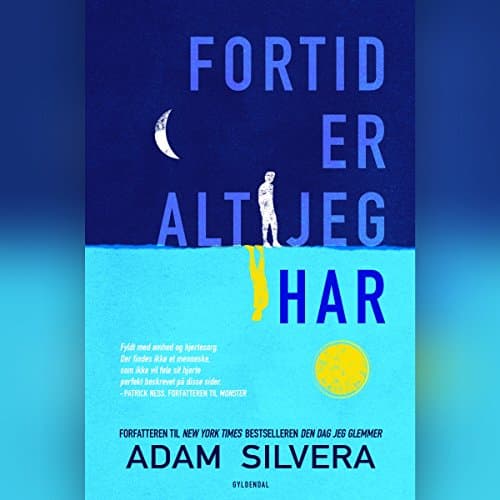
The book's Danish title - "Fortid er alt jeg har" (the past is all I have) - actually captures Griffin's trap better than the English title. He's defined himself entirely by what's already gone. And the question the book asks isn't "will he get better?" It's "will he choose to?"
Who Gets This Book (And Who Should Skip It)
If you've ever grieved someone who was already gone before they died - someone who left you before they left the world - this book will find that bruise and press on it. My heart. MY HEART. I ugly-cried around hour seven, not at the sad part you'd expect but at a small moment of Griffin almost choosing honesty and then pulling back. If you connect with raw, unflinching portrayals of mental illness and messy grief - listen. If you need a narrator who goes big with the emotional moments, skip this Danish version and try the English audiobook instead.
But if narration needs to carry the emotional weight for you, this version might leave you wanting. The story does the heavy lifting here. The performance supports it but doesn't elevate it.
This is a rainy Sunday book. Headphones on. Phone off. Let it wreck you on purpose. The Women earned the same Sunday-afternoon-ruins-you treatment from me, though that one wrecked me in a completely different register.
(I added it to my crying spreadsheet. That's 48 now.)