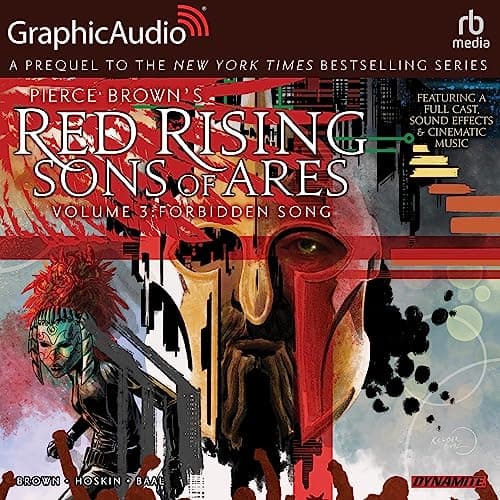

I was halfway through reorganizing my board game shelf — trying to fit Gloomhaven back into its box, which is basically a spatial reasoning test I fail every time — when the final act of Forbidden Song kicked in and I just... sat down on the floor surrounded by cardboard tokens and listened. Didn't move for forty minutes. My Gloomhaven pieces are still scattered across the living room. Worth it.
So look, I need to be upfront about something: this is a 3-hour-39-minute dramatized audio adaptation of a graphic novel spinoff set in Pierce Brown's Red Rising universe. That's a lot of qualifiers. And if you're coming in expecting the sprawling 20+ hour epic that is Red Rising proper, you need to recalibrate your expectations immediately. This is a different beast — tighter, more focused, and honestly? Kind of brilliant in what it's trying to do.
Fitchner's Heist Deserves Its Own Campaign Module
The pitch for Forbidden Song is "one part Ocean's 11, one part Les Misérables," and that's... actually pretty accurate? Fitchner au Barca — Ares himself, the guy who lit the fuse that Darrow eventually carries — is running a long con against the Gold establishment, and the structure here is pure heist energy. You've got the crew assembly, the impossible plan, the double-crosses. If I were running this as a D&D campaign, it'd be a Tier 3 intrigue arc where every NPC has their own agenda and the party's rogue is secretly the BBEG's dad. (My D&D group would love this.)
What makes it work is that this is the payoff volume. Books one and two put Fitchner through the wringer — desperate rescue mission, betrayal by Arturius and Quicksilver — and now he's the one holding the cards. Watching him shift from reactive to proactive, from desperate husband to calculated revolutionary leader, gives the whole trilogy an arc that honestly enhances the main Red Rising series. You understand why the Sons of Ares exist by the time this wraps, not just that they exist.
GraphicAudio Doing What GraphicAudio Does
The production here is full-cast dramatized — we're talking 20+ voice actors, sound effects, cinematic score, the works. Richard Rohan anchors the thing as Fitchner with this gravelly authority that shifts between cold strategist and barely-contained rage depending on the scene. It's a performance that reminded me of what Steven Pacey does with Logen Ninefingers — not the same voice, but the same commitment to letting a character's violence simmer under the surface of every line. Holly Adams and Todd Scofield fill out the supporting cast with enough distinction that you never lose track of who's talking, which in a full-cast production with this many characters is genuinely impressive.
The sound design does real work here. Sword impacts have weight to them, the ambient noise of Gold society sounds appropriately cold and sterile, and the score swells during the heist sequences without drowning out dialogue. Compare this to, say, the Star Wars "From a Certain Point of View" audio productions — Forbidden Song is more cinematic, less radio-play. It wants to be a movie in your ears, and it mostly succeeds. That same cinematic ambition — full cast, score that knows when to shut up, sound design that earns its keep — is something I ran into with Towers of Midnight too, where the sheer production commitment to a sprawling world made every scene feel like it had a budget.
Now, here's the thing I have to be honest about: at 3 hours and 39 minutes, this is short. Like, one-session short. The graphic novel source material means the pacing is compressed — scenes move fast, emotional beats get less room to breathe than they would in a Pierce Brown novel. There are moments where I wanted to sit with Fitchner's grief or his fury a beat longer, but the format just rockets forward. It's not a flaw exactly, but if you're used to Sanderson-level world-building where you get 200 pages of political maneuvering before the climax, this will feel like someone hit 2x speed on your epic fantasy.
The Red Rising Expanded Universe Problem (And Why This Mostly Dodges It)
I'm generally skeptical of franchise spinoff audio. A lot of it feels like homework — stuff you listen to because you love the main series, not because it stands on its own. Forbidden Song earns its existence because Fitchner's story genuinely recontextualizes what happens in Red Rising. The ending here — the fuse being lit, the pieces being placed — hits different when you know what Darrow inherits. It's like reading a really good prequel campaign sourcebook that makes your main campaign richer.
But I won't pretend it works as a standalone. If you haven't read Red Rising, half the emotional weight evaporates. The Gold-Red-Color hierarchy, the significance of Ares as a figure, the personal cost of Fitchner's choices — all of that requires context this adaptation doesn't provide. It assumes you're already a Howler.
Who Should Listen (And Who Should Skip)
If you're deep in the Red Rising universe and want Fitchner's full story with cinematic production values, this is an easy yes — grab it, clear one evening, and don't bother pausing. Skip it if you haven't read the main series (you'll be lost) or if sub-four-hour runtimes leave you feeling short-changed on your fantasy fix.
My Thesis Can Wait, But This Can't (Actually It Can, It's Three Hours)
I listened to this instead of writing my thesis. In one sitting. On my apartment floor. Surrounded by board game pieces. And honestly? For fans of Brown's universe, this is the capstone to a spinoff trilogy that punches way above its weight class. The production quality is excellent, the voice cast commits fully, and Fitchner's arc across three volumes is genuinely satisfying — from desperate outsider to revolutionary mastermind.
But that runtime and that graphic-novel compression mean you're getting a shot of espresso, not a full pot of coffee. Sometimes that's exactly what you need.