
What's the ROI on grace?
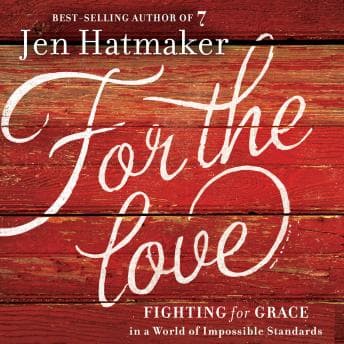
I know, I know. That's a weird question. But when you spend your career measuring business outcomes, you start thinking about everything in terms of returns. And here's the thing - Jen Hatmaker's "For the Love" is basically a 5-hour pitch deck for why grace is the most underutilized asset in modern life. Especially for women drowning in impossible standards.
Let me be upfront: this isn't my usual lane. Jenny handed me her AirPods after a particularly brutal consulting week and said, "You need this more than you think." She was right. (Don't tell her I said that.)
The Business Case for Letting Go
Hatmaker's thesis is simple: we're all exhausted from trying to be perfect, and the solution is grace - for ourselves, for our messy relationships, for the whole Pinterest-curated disaster we've built. She's not reinventing the wheel here. My parents practiced this instinctively - they didn't have time for perfectionism when they were running a dry cleaning business 14 hours a day. They just... did the work. Loved each other. Showed up. That same practical approach to relationships shows up in 5 Love Languages, though Gary Chapman's framework is more diagnostic than inspirational.
But here's where Hatmaker earns her keep: she articulates what a lot of people feel but can't name. The chapter on "impossible standards" hit different. I've seen this exact dynamic destroy startup founders - the ones who think they need to be crushing it on every metric, every day, or they're failures. Spoiler: they burn out. Every time.
The key takeaway is worth the listen. The other 4 hours? Mixed bag.
When the Sermon Becomes a Rant
Look, I listened at 1.5x (slower than usual for me, because Hatmaker's delivery is actually worth savoring), and even then some chapters felt like they wandered off the reservation. She's funny - genuinely funny - but there are moments where the humor gives way to what feels like venting. And I get it. She's processing real frustrations. But as a listener, I found myself checking how much time was left.
The parenting stuff in particular - some of it lands, some of it made me think, "This is very specific to her life and maybe not universally applicable." Which is fine. Not every chapter needs to be a universal truth bomb. But if you're expecting a tightly structured argument for grace, you're getting more of an essay collection. Think blog posts stitched together, not a cohesive manifesto.
My 2.0x speed couldn't save this one. (Okay, I didn't actually try 2.0x. Jenny would've noticed.)
Hatmaker Narrating Hatmaker
Here's the thing that actually works: Jen reads her own stuff, and it shows. There's a warmth in her delivery that you don't get from a hired narrator. When she's telling a story about her kids or her own failures, you believe her. It's not polished in a radio-announcer way - it's polished in a "I've told this story at a dinner party twelve times" way.
The comedic timing is solid. She knows when to pause, when to let a joke breathe. Some of the heavier emotional moments hit harder because she's not overselling them. She just... says it. And you feel it.
Some listeners apparently found it preachy. I can see that. If you're not already bought into her worldview, the enthusiastic delivery might feel like you're being recruited. I didn't have that problem, but I can see how someone would.
Who Should Listen (And Who Should Skip)
This audiobook is a solid investment if you're a woman (or married to one, or managing one, or just... living near one) who's drowning in the expectation trap. It's encouraging without being saccharine. It's Christian without being preachy - mostly. And it's funny enough to keep you engaged during a commute. Skip it if you need tight structure and zero tangents - there's padding here that'll frustrate the efficiency-minded.
But it's not efficient. There are tangents. If you're the type who wants every minute to deliver value, you'll be frustrated.
Jenny loved it. I appreciated it. We're calling that a win.
Would I recommend it to a client? Depends on the client. For the overachieving, perfectionist type who's about to burn out? Yeah, actually. Skip to the chapters on grace and impossible standards. The rest is optional.
Finally, a faith-based book that respects your intelligence. Even if it doesn't always respect your time.









