
"I'm like you. I don't want to let go either."
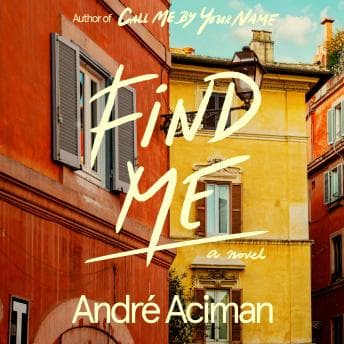
That line hit me somewhere around hour six, while Denise and I were walking the lakefront on a Sunday morning that had no business being as cold as it was. She asked me why I'd gone quiet. I didn't have a good answer. The honest one was that Aciman had just gutted me with a sentence that sounds like nothing on paper but, in Michael Stuhlbarg's raspy whisper, felt like an entire life condensed into eight words.
But here's the thing — and I need to be honest about this — Find Me is not Call Me by Your Name. It's not trying to be. And if you come to it expecting the same electric, aching intimacy between Elio and Oliver, you're going to be disappointed. A lot of people were. I understand why.
The Father Gets the Best Chapter (and Maybe the Best Love Story)
The book opens with Samuel — Elio's father, Sami — on a train from Florence to Rome, and this first section is where Aciman is working at his sharpest. Sami meets a younger woman, and their conversation unfolds with this intellectual flirtation that feels distinctly European, distinctly Aciman — all allusion and indirection, two people circling each other through references to books and music rather than saying what they actually mean. This reminds me of what Hemingway said about the dignity of an iceberg. Except Aciman's iceberg is wearing a linen suit and quoting Leopardi.
Stuhlbarg — who played Sami in the film, remember — sounds completely at home here. His voice has this rough warmth, like aged leather, and when he's narrating Sami's internal monologue, you believe every word. The man knows this character from the inside out. There's a particular tenderness in how he handles Sami's vulnerability, a man in his sixties allowing himself to feel something unexpected. The prose deserves to be savored, and Stuhlbarg savors it.
Where things get complicated is when the perspective shifts. We move to Elio in Paris, then eventually to Oliver in New England, and Stuhlbarg is still the sole narrator for all three. For Sami? Perfect. For Elio and Oliver? It's... odd. Not bad, exactly. But you're hearing a man in his fifties voice characters who are supposed to be younger, and the whispery intimacy that works beautifully for a father reflecting on love feels less convincing for a young pianist navigating a new affair in Paris. The narrator understands that pause is punctuation — and he uses silence brilliantly — but the single-voice approach asks a lot of the listener when the POV keeps rotating.
Aciman's Beautiful Problem
Let's talk about what the author is really saying. Because I think people who call this book "meandering" are actually identifying Aciman's central project here without realizing it. This isn't a plot-driven novel. It's barely a novel, honestly. It's three meditations on love at different life stages — the widower, the young artist, the closeted professor — stitched together by the Perlman family's gravitational pull.
And two of those meditations are gorgeous. Sami's train encounter is genuinely moving. Oliver's quiet reckoning with the life he built versus the life he wanted carries real weight. But Elio's Paris section — the middle of the book — drifts. His affair feels less consequential, more like Aciman filling space between the two stories he actually wanted to tell. My students would hate this. Though when it comes to books that ask readers to sit with emotional weight rather than plot momentum, I had a similar push-pull reaction to Nightingale — I kept resisting it and then, without quite noticing when it happened, I was wrecked by it. I love it. (Well, two-thirds of it.)
The writing itself is pure Aciman — those long, recursive sentences where a character will feel something, then question whether they're really feeling it, then wonder what it means that they're questioning it. If you loved Call Me by Your Name, this is its spiritual successor in style if not in story. But eight hours of that internal circling, without the propulsive longing of the first book, requires patience. This is focused listening. Don't put this on while grading papers at 11 PM. (I tried. I had to rewind three times.)
The Bonus Conversation You Shouldn't Skip
The conversation between Stuhlbarg and Aciman at the end is worth the price of admission on its own. Two intelligent men talking about how stories continue beyond their endings, how characters live in the space between books. It gave me more insight into Aciman's intentions than any review I'd read. Worth pausing the faculty meeting for.
Who This Is Really For
If you want the sequel to Call Me by Your Name — Elio and Oliver, older, reunited, working it out — this isn't that book. Not until the final section, and even then, Aciman gives you something more elliptical than satisfying. But if you want to sit inside Aciman's particular frequency — that ache of wanting what you're afraid to name — and you want it delivered by a narrator who treats every sentence like it matters, Find Me has real rewards. Especially that train. God, that train.
Just don't expect the destination. Aciman's always been more interested in the reaching.