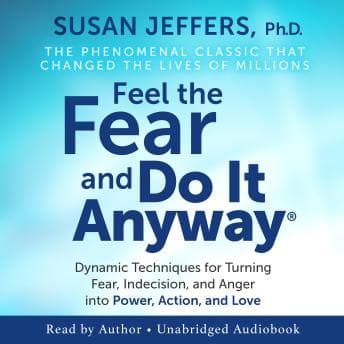

"At the bottom of every one of your fears is simply the fear that you can't handle whatever life may bring you."
I paused the audio right there. I was standing in my kitchen, knife in hand (chopping cilantro, calm down), and I just stared at the counter. Because—damn. As a researcher, I spend half my life complicating human emotion with academic jargon. Jeffers just cut through the noise in one sentence. That's the thing about classic self-help—sometimes it's cheesy, and sometimes it just rips the rug out from under your neuroses.
Your Grandmother's Therapist Voice
Here's the deal with the narration. Susan Jeffers reads this herself, and she doesn't sound like the high-octane "crush it" bros that dominate the self-help charts today. She sounds like a very patient, very wise grandmother who is gently suggesting you stop ruining your own life.
At first? I hated it. (I know, I know). I was on my run along the Charles River, trying to get pumped up, and her voice was so... soothing. It felt wrong. I actually checked my phone to make sure I hadn't accidentally clicked on a guided meditation. It lacked that aggressive "let's go!" energy I usually crave when I'm trying to outrun my impostor syndrome.
But then—and this is where the discovery kicks in—I realized that's the point. Fear is frantic. Fear is loud. You don't fight fear with more noise. You fight it with this kind of steady, unshakeable calm. By Chapter 3, I wasn't running faster, but I was definitely breathing deeper. (Though, full disclosure: I bumped the speed to 1.25x. I have patience, but not that much patience).
The CBT Trojan Horse
Psychologically speaking, this book is a Trojan Horse for Cognitive Behavioral Therapy and exposure therapy. Jeffers frames it as "feeling the fear," but what she's really describing is behavioral activation.
She talks about the "Chatterbox"—that inner voice of doom. We all have it. Mine tells me nobody reads my papers. Jeffers argues you can't silence the chatterbox, but you can out-act it.
I found myself nodding along when she dissected the paralysis of decision-making. The idea that there are no "wrong" decisions, only different paths with different learning opportunities? It's textbook reframing. My mother would say it's just common sense, but sometimes you need a PhD to tell you the obvious before you actually listen. There's a section on "Pollyanna" thinking—saying yes to everything—that made my cynical side twitch a little, but the underlying logic holds up. You act your way into a new way of thinking, not the other way around. Mindful Athlete operates on the same principle—action first, mindset follows—though it applies the framework specifically to performance anxiety.
Who This Works For (And Who It Won't)
If you're looking for a drill sergeant to scream at you until you hustle, skip this. Seriously. You'll be bored to tears. The vibe is very gentle, very 1980s support group.
But if you're paralyzed by "what ifs"—if you're the type to rewrite an email five times before sending (guilty)—this is a warm blanket that also somehow kicks you in the pants. Gentle, but it doesn't let you off the hook.
Folding Laundry, Sorting Fears
I ended up finishing this while folding laundry instead of running. It just fit the headspace better. It's not a hype track; it's a reset button.