
"You can't go home again, but home can sure as hell come find you."
That line hit me somewhere around hour three, and I had to pull over. Literally. Sitting in a Buc-ee's parking lot outside San Antonio, staring at nothing while Tim Gerard Reynolds kept talking in my ear. Look, I've done three tours in places where people were actively trying to kill me, and this book about a Dublin detective going back to his childhood neighborhood somehow got under my skin in ways I wasn't prepared for.
The Mission Brief
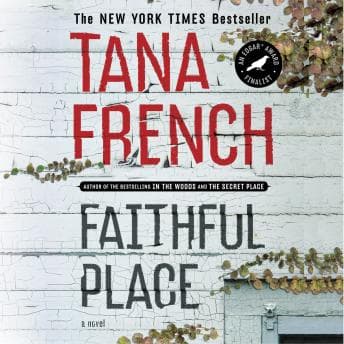
Let me cut to the chase: Frank Mackey is an undercover cop who's spent twenty-two years running from Faithful Place—a cramped Dublin street full of broken families and broken dreams. His girlfriend Rosie was supposed to run away to London with him back in '85. She never showed. He assumed she'd ghosted him (though we didn't call it that back then), and he never looked back.
Then her suitcase turns up behind a fireplace in an abandoned house. Suddenly Frank's not just a detective—he's a suspect, a witness, and the kid who never quite escaped his past, all wrapped into one very angry Irishman.
Tana French does something here that most thriller writers can't pull off: she makes the family drama hit harder than the murder mystery. And I mean that as a compliment. The Mackey family is a tactical nightmare—alcoholic father, manipulative mother, siblings who've been weaponizing their dysfunction for decades. Watching Frank navigate that minefield while trying to solve a cold case? It's like watching someone defuse an IED while their relatives keep handing them the wrong tools.
Reynolds Owns Every Voice
I've listened to a lot of audiobooks with Irish accents done badly. American narrators who sound like they learned Irish from a Lucky Charms commercial. Reynolds isn't that. The man IS Frank Mackey for sixteen hours straight, and I never once questioned it.
Here's what impressed me: he voices Frank's family—all of them—and you can tell who's talking without French having to write "said Jackie" or "said Shay" every time. The mother's passive-aggressive sweetness. The father's slurred belligerence. Frank's sister Carmel, who's so desperate to keep the peace she'd probably negotiate with the Taliban if they asked nicely. Each one distinct. Each one recognizable.
The pacing works too. Sixteen hours is a commitment, and yeah, there are stretches in the middle where the family dynamics take center stage and the murder investigation takes a backseat. Some listeners might find that frustrating. I didn't. French is doing something tactical here—she's showing you why Frank ran, and why running didn't help. The mystery isn't just "who killed Rosie." It's "what happens when you think you've escaped something, and you haven't."
(Ranger perked up during a few of the more intense family arguments. He's heard me yell at the TV during Cowboys games, so he knows the difference between real anger and performance anger. Reynolds had him convinced.)
Where It Lost Me—Briefly
I'll be honest: around hour ten, I started getting impatient. Frank's ex-wife Olivia shows up periodically to remind him he's a terrible father, and while I get that it's thematically important, some of those scenes felt like they were retreading the same ground. "You're damaged, Frank." "I know I'm damaged, Olivia." "Well, stop being damaged around our daughter." We get it.
But then French pulls you back in with a revelation that reframes everything. Won't spoil it. Just know that around hour twelve, I was back to white-knuckling the steering wheel.
The Tactical Assessment
This isn't a fast-paced thriller. If you want explosions and car chases, this ain't it. What French delivers is something more like a psychological siege—slow, methodical, and devastating. She understands something that a lot of writers don't: the worst damage usually comes from the people who are supposed to love you. Mad Honey explores that same brutal truth about family secrets and the damage parents can do.
The mystery itself is solid. The resolution makes sense without being predictable. And Frank Mackey is one of the more honest portrayals of a cop I've encountered in fiction—flawed, stubborn, occasionally cruel, but trying to do right by the people who matter. Reminds me of a few NCOs I served with. The kind of guys who'd take a bullet for you but couldn't figure out how to say "I love you" to their own kids.
Who Gets the Green Light
If you've got family baggage—and who doesn't—this book will make you feel things you weren't planning to feel. If you want a procedural that's also a character study, French delivers. Skip it if you need action every chapter; sample first.
I listened at 1.25x because life's too short for slow narrators, and Reynolds holds up fine at that speed. The Dublin accents stay intelligible, and the pacing actually tightens up a bit.
Ranger approved this one. He fell asleep during the quieter family scenes, but he was alert for the climax. Good enough endorsement for me.