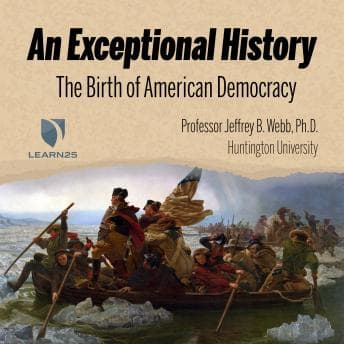

I've sat through more briefings on American history than I care to count. Pentagon PowerPoints, mandatory training sessions, the works. So when I say Jeff Webb's lecture series actually kept me awake during a six-hour drive from Austin to El Paso, that's saying something.
But here's my gripe right off the bat—and I'm gonna be straight with you. This isn't the deep operational analysis I was hoping for. It's more like a really good overview briefing. The kind where your S-2 gives you enough context to understand the mission without drowning you in classified appendices. That's not necessarily bad. It just depends on what you're looking for.
The Professor Who Gets It
Webb narrates his own material, which I generally appreciate. Nothing worse than some actor reading history like they're selling car insurance. Webb sounds like what he is—a guy who's spent decades thinking about this stuff and actually enjoys explaining it. His pacing is solid. Clear, methodical, no verbal tics that made me want to punch my dashboard.
That said, there were moments where I wished he'd punch it up a bit. Some of the lectures feel a little too... academic? Like he's still in a classroom rather than in my truck cab. But honestly, for a history professor doing his own narration, he's better than most. Ranger didn't even look up when Webb was talking, which means the voice wasn't grating. (Trust me, my dog has opinions about narrators.)
Where the History Actually Lands
Here's what Webb does well—he doesn't treat American democracy like it was some inevitable destiny. That drives me crazy when people do that. Like somehow the Founders just showed up, wrote some documents, and boom, freedom. Webb gets into the messiness. The weight of tradition pushing against new ideas. The fact that most colonists weren't sitting around dreaming of revolution.
The sections on less-famous figures like John Winthrop and Robert Keayne? That's where it got interesting for me. I've read plenty about Jefferson and Adams. But the smaller players, the ones whose decisions actually shaped how communities organized themselves—that's the ground-level intelligence I was missing.
Bacon's Rebellion got a solid treatment too. Most people have never heard of it, but Webb makes a convincing case for why it matters. These are the kinds of historical pressure points that help you understand how we got from colony to nation. That same focus on overlooked turning points is what made Thirty Years A Slave hit so hard for me—the ground-level view changes everything.
The Brief That Could Go Deeper
Now for the honest debrief. At just over six hours, this is tight. Fifteen lectures covering 1607 to 1790. That's a lot of ground, and sometimes you can feel Webb sprinting through material that deserves more time.
Some reviewers have complained it feels like a summary rather than a deep dive. I get that criticism. If you've already read serious academic work on the colonial period, this might feel like review. But if you're looking for a solid foundation—something to listen to before tackling heavier material—this does the job.
The audio quality is clean. No weird background noise, no production issues that pulled me out of the content. There's apparently some bonus material with additional interviews, which I didn't get to yet but plan to circle back on.
Who's This Mission For?
If you want a lecture series you can absorb on a road trip without needing to rewind constantly, this works. Good for history newcomers or anyone wanting a refresher before diving into heavier academic material. Skip it if you've already done serious reading on the colonial period—you'll be covering familiar ground.
Mission Debrief
Let me cut to the chase. This is a good introduction, not a comprehensive analysis. Webb knows his stuff and communicates it clearly. He doesn't oversimplify, but he also doesn't get into the weeds the way some of us history nerds might want.
If you're the type who thinks American democracy just happened because we're special, this will correct that misconception. Webb makes clear how fragile and contested the whole experiment was. That's a message worth hearing, especially now.
For a different kind of historical immersion—one that'll gut you but stick with you—Zookeeper's Wife: A War Story delivers that emotional weight Webb sometimes skips over. If you want deep analysis that'll have you pulling over to take notes, look elsewhere. Maybe pair this with something like "A People's History" for a different perspective.
Ranger approved it. I approved it. Mission accomplished—just know what mission you're signing up for.







![Steve Jobs [unabridged audiobook] audiobook cover](/_next/image?url=https%3A%2F%2Fcovers.audiobooks.com%2Fimages%2Fcovers%2Ffull%2F9788499923406.jpg&w=1920&q=75)