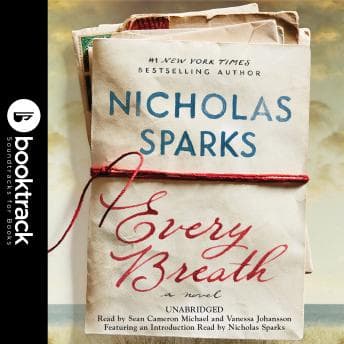

So here's the thing about Nicholas Sparks — everyone has an opinion. He's either your guilty pleasure or your literary punching bag, and I've been on both sides of that fence. But I came into Every Breath during a late Tuesday night, halfway through a rebrand project for a local mezcalería, Frida asleep on my keyboard and Diego doing that thing where he stares at me like he knows I'm about to emotionally unravel. And unravel I did. Just not in the way I expected.
People will tell you this is classic Sparks formula. Star-crossed lovers, a beach, impossible choices, someone probably crying in the rain. And yeah, on paper? Sure. But what got me was the specificity of Tru Walls — a Zimbabwean safari guide who's never left Africa, summoned to North Carolina by a letter from a man who might be his father. That's not generic romance setup. That's a man standing on foreign sand trying to piece together a dead mother's secrets while accidentally falling for a woman who's been treading water in her own life for six years. Hope Anderson isn't just "woman at a crossroads." She's a woman watching her father disappear to ALS while her surgeon boyfriend treats their relationship like a surgery he keeps postponing. The weight of that — the specific, ugly weight of watching someone you love lose themselves while you're losing yourself too — Sparks gets that right. Jojo Moyes does something similar with that particular flavor of grief-layered-over-romance in One Plus One — characters so waterlogged by their own circumstances that falling for someone feels less like choice and more like survival.
Sean Cameron Michael's Voice Is the Whole Damn Sunset
Okay, I need to talk about Sean Cameron Michael because his South African accent does something really interesting here. When he voices Tru, there's this quiet steadiness — like a man who's spent his life reading animal behavior and applies that same patience to humans. It's not showy. It's not "listen to my sexy accent" energy. It's grounded. You believe this man has sat in silence watching elephants for hours. You believe he'd notice the way Hope tucks her hair behind her ear before she says something honest. His delivery in the intimate moments between Hope and Tru is gentle without being saccharine, which — for a Sparks audiobook — is a minor miracle.
Vanessa Johansson handles Hope's chapters with a softer, more internal quality. She's good. She's fine. But I'll be honest — next to Michael's natural gravity, her sections sometimes felt like they needed a little more edge, a little more of the quiet desperation Hope is supposed to be drowning in. It's not bad narration. It's just that Michael set a bar and Johansson is reaching for it rather than matching it.
The Booktrack Problem (Or: Why Is There a Violin Following Me)
Now. The elephant in the room. This is the Booktrack Edition, which means there is continuous background music woven through the entire audiobook. And I have feelings.
I design with music on constantly — lo-fi, ambient, sometimes full orchestral scores depending on the project. So I'm not anti-background music in theory. But the Booktrack here felt like someone put a Spotify "Emotional Piano" playlist on shuffle underneath a perfectly good narration. During quiet, devastating moments between Hope and Tru, there's this swell of strings that tells you HOW TO FEEL before you've had the chance to feel it yourself. It's like when a telenovela cuts to commercial with that dramatic sting — except Abuela's telenovelas earned those stings, you know? Here it sometimes felt like emotional training wheels on a story that could've stood on its own legs.
There were moments — a few — where the music and narration clicked, where the ambient beach sounds made me feel like I was standing on Sunset Beach at dusk. But more often, I caught myself wishing for silence. For just Michael's voice and the weight of what he was saying.
If there's a non-Booktrack version, get that one. Seriously.
The Cry Count (Because You Know I Kept Track)
Two real cries. One during Hope's realization about her father — there's a scene where she's sitting with him and he can barely speak and she's trying to memorize his voice before it's gone, and I had to pause my design work because my hands were shaking. (Abuela would have loved this one. She would've grabbed my hand during that scene and not let go.) The second was the ending, which I won't spoil, but Sparks does that thing where the years pile up and you realize time is the real villain of every love story.
But here's my honest take: I wanted to cry more. The bones of this story are devastating — two people who find each other at exactly the wrong time, whose connection spans decades and continents. But some of the plot mechanics felt too neat, too coincidental, like Sparks was moving chess pieces rather than letting these people breathe. The emotional peaks are real, but the valleys between them sometimes flatten out.
Who Gets the Tissues, Who Keeps Walking
This is a rainy Sunday book. If you love Sparks and want a slow, aching love story with a genuinely interesting male lead and narration that'll make you believe in Tru Walls as a real human being — yes. Get this. If you need your romance to move fast or if manufactured coincidences make you roll your eyes, this might test your patience. And for the love of everything — avoid the Booktrack Edition unless you genuinely enjoy background music with your audiobooks. It's the difference between crying because you felt something and crying because a violin told you to.
My heart is tender but not broken. Three sessions of misty eyes, two full cries, zero regrets. That's a decent Tuesday night.