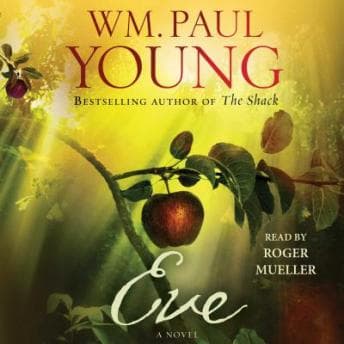

Everyone told me this would be The Shack 2.0. That I'd get the same warm spiritual hug, the same accessible theology, the same tears-in-my-coffee experience. They were wrong. Not because Eve is worse - though I have opinions on that - but because it's doing something stranger, more ambitious, and honestly more confusing than anything Paul Young has attempted before.
I started this one on a Saturday morning walk along the lakefront with Denise. She was half a step ahead of me, pointing out the ice forming on the rocks, and I was trying to figure out why a young woman was washing up in a shipping container on a mystical island between worlds. By the time we'd circled back to Montrose Harbor, I still wasn't sure what kind of book I was listening to. And look - I teach English. I'm used to sitting with ambiguity. I tell my sophomores three times a week that confusion is the first step to understanding. But Eve tested even my patience for that particular sermon.
Genesis Remixed Through a Funhouse Mirror
Here's what Young is doing, and I respect the audacity of it: he's taking the Creation narrative and running it through a speculative fiction blender. John the Collector finds this broken woman in a shipping container, and through the intervention of Healers and Scholars (capitalized, because everything on this island carries theological weight), she's nursed back to health. Her genetic code connects her to every known race. Then Eve herself - Mother of the Living, the Eve - shows up and calls this woman "daughter" and begins unpacking the real story of Eden.
It's a framework for Young to argue that centuries of patriarchal interpretation have corrupted our understanding of men, women, and what equality looked like before the Fall. And when it works, it genuinely works. There are moments where Young's reading of the Hebrew texts feels electric - like he's found a thread in the weave that everyone else walked past. But the narrative scaffolding around those ideas? That's where things get wobbly. The island setting, the Collectors, the Scholars - it all feels like a lot of furniture arranged around a TED talk. The story keeps stopping to teach you something, and my teacher radar goes off every time because I recognize the move. I do it myself. Doesn't mean it makes for great fiction.
Letty the nurse - this dwarf-sized character with an outsized personality - is one of the few figures who actually breathes on her own. She's quirky and warm and the kind of character who makes you lean in during her scenes rather than waiting for the next theological download. Young clearly loves her. I wish there were more characters he loved that much.
Roger Mueller Carries What the Prose Can't
And now let me talk about Roger Mueller, because this man is doing heavy lifting. The consensus I've seen is that Mueller "saves" a confusing story, and I wouldn't go quite that far - you can't narrate your way out of structural problems - but he absolutely elevates every scene he touches. His pacing through the denser philosophical passages is careful and clear, which matters enormously when Young is layering mythic language over theological argument over speculative worldbuilding. A lesser narrator would've turned those sections into white noise.
What impressed me most was how Mueller handles Letty. There's a slight shift in register - not a full character voice, but a tonal warmth, a quickening - that gives her scenes their charm. He does this with subtle adjustments rather than big theatrical choices, and at 1.0x speed (yes, I listened properly, thank you), you can hear every deliberate pause he places around Young's weightier lines. The narrator understands that pause is punctuation. The minimal background music works too - unobtrusive, spiritual in tone, never competing with Mueller's delivery.
My one wish? A touch more vocal distinction between the Scholars and other male figures, who occasionally blend together. But that's a minor gripe.
Who Gets the Most Out of This
If you loved The Shack and want more of Young's theological imagination, you'll find it here - just be ready for a weirder, more demanding container (pun intended). If you're someone who enjoys books that reexamine scripture through fresh eyes - the way Marilynne Robinson does in her nonfiction, or the way C.S. Lewis played with myth in Till We Have Faces - there's real substance to chew on. This is why we still read the classics, even when they come disguised as speculative fiction.
But if you need a strong narrative engine to carry you through nine hours? If you get frustrated when a novel feels more like a theological treatise wearing a plot like an ill-fitting coat? You might struggle. My students would hate this. I... mostly liked it. With reservations. The same warning applies to Head Full of Ghosts — another book that demands you show up fully awake, because the moment you let your attention slip, you've lost the thread entirely.
This is a focused-listening book. Don't try it while grading papers at 11 PM. Don't try it at a faculty meeting. (Not that I would ever listen to audiobooks during faculty meetings, Principal Martinez.) Give it a quiet room, or a long walk, or a Sunday afternoon with nowhere to be.
The Grade I'd Write in the Margin
Eve is a book with a bigger brain than it has a heart. The ideas are genuinely interesting - Young's argument about gender equality rooted in Creation is worth the price of admission. Mueller's narration is skilled and steady. But the story itself doesn't quite earn its ambitions. It's the kind of book I'm glad I listened to and probably won't revisit. Like a really good sermon you appreciated in the moment but couldn't quote a week later.
Worth your time if you're in the right headspace. Not worth rushing to.