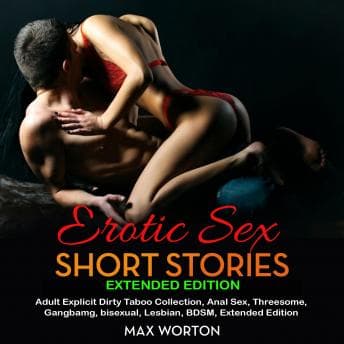

What happens when you spend twenty years teaching teenagers the difference between good prose and bad prose, and then you accidentally press play on something that makes your students' worst creative writing assignments look like Hemingway?
I'll tell you what happens. You sit there at 11:30 PM, supposedly grading a stack of sophomore essays on The Great Gatsby, and you listen to this thing with the same horrified fascination you'd give a car wreck on the Dan Ryan Expressway. Denise walked through the living room, heard about fifteen seconds through my headphones (they were louder than I thought), gave me a look that could've curdled milk, and went to bed without a word. I deserve that.
Why a High School English Teacher Pressed Play on This
Look, I try to be fair. I genuinely believe every genre has its craft. Erotica has a literary tradition stretching back centuries - Anaïs Nin, Henry Miller, the Story of O. There's a version of this collection that could work: short, punchy stories with tension, desire, psychological complexity. The description promises "high passion and emotion" in the author's "signature style." So I gave it the same benefit of the doubt I give my students when they tell me their essay is "almost done."
But here's the thing about erotica as a genre - it lives or dies on two things: voice and tension. You need a narrator (literary or literal) who makes you believe in the desire on the page. And the writing needs to build something before it pays off. This collection does neither. The prose reads like it was generated by someone who'd heard descriptions of intimacy but never actually encountered a human sentence with rhythm or surprise. Repetitive phrasing, flat emotional beats, and dialogue that no living person has ever spoken. My students would hate this. And for once, they'd be right.
Two Narrators, Zero Chemistry
The audiobook features Lory Nilson and Luana Maranz, and I want to be careful here because narration is genuinely difficult work. I've listened to hundreds of audiobooks at this point, and I know the difference between a narrator fighting bad material and a narrator phoning it in. This felt like both, simultaneously. The delivery is flat where it should smolder and rushed where it should linger. Erotica in audio form demands something from a performer - a willingness to inhabit the words, to find the heat in a pause, the tension in a breath. The narrator understands that pause is punctuation - or at least, a good narrator does. Here, the reading sounds like someone working through a checklist rather than performing a story.
One listener review I came across summed it up with brutal economy: "Badly written and worse narration as well." That's a tough combination. Bad writing can sometimes be rescued by a narrator who commits fully to the material - I've heard voice actors elevate mediocre thrillers into something genuinely entertaining through sheer force of performance. The narration in All the Light We Cannot See is the clearest example I can point to of a reader and material working in perfect lockstep - which is exactly why the contrast here stings. And good writing can survive a middling narrator because the sentences themselves carry weight. But when both elements are struggling? There's nowhere to hide.
At nearly eight hours, this is a significant time commitment. For comparison, you could listen to the entirety of Lady Chatterley's Lover in roughly the same span and get actual literary erotica with psychological depth, class commentary, and prose that D.H. Lawrence sweated over. The difference isn't just quality - it's intention. Lawrence was trying to say something about desire and freedom. This collection is trying to fill a content quota.
Who This Is (and Isn't) For
I'm not going to pretend I'm the target audience. I'm a 50-something English teacher who gets excited about semicolons. But I don't think the target audience is well-served here either. If you're looking for erotic audio, there are collections with real craft - narrators who understand pacing, writers who understand that anticipation is half the experience. This isn't that. The variety of scenarios promised in the description (and yes, it covers the listed categories) doesn't compensate for the flatness of execution. Variety without quality is just a longer menu at a bad restaurant.
If you loved Anaïs Nin's Delta of Venus or even well-produced contemporary erotica anthologies, this is not their spiritual successor. It's the knockoff you find in the clearance bin and regret at checkout.
The Red Pen Comes Out
I grade on effort, clarity, and craft. This gets a generous score for at least existing as a completed audiobook with two narrators and eight hours of content. But I can't recommend spending a credit - or even streaming time - on something that fails at the fundamental level of sentence construction and vocal performance. Life's too short, and there are too many good books waiting. I should've been listening to Middlemarch. I'm always better off listening to Middlemarch.