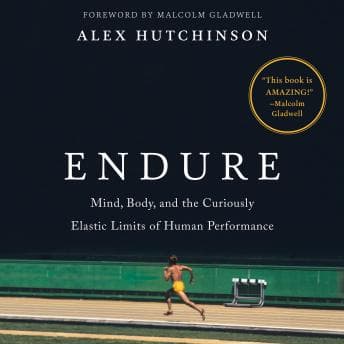

Let's get the annoyance out of the way first. Because as a guy who spent a decade obsessing over slide deck typos, this stuff keeps me up at night.
If you're going to narrate a book about the history of running and endurance, learn how to pronounce the athletes' names. Seriously. It's not that hard. Google exists. Robert G. Slade has a great voice—warm, engaging, enthusiastic—but every time he butchered a famous runner's name, I twitched. It's like hearing someone say "chip-o-tull" instead of Chipotle. It breaks the spell. (And yes, I know I'm being pedantic. Jenny tells me to let it go. I can't let it go. Details matter.)
Okay, rant over. Now the actual ROI of the book.
The Physics of Suffering
Most "endurance" books are just retired Navy SEALs yelling at you to stop being soft. Which, fine. I get it. But Hutchinson is different. He's a physicist and a runner. He brings data to the pain cave.
This isn't about "believing in yourself." It's about oxygen uptake, fuel depletion, and the central governor theory—the idea that your brain shuts you down way before your body actually fails. It's a safety switch. I've seen this in business. Founders burn out not because they run out of cash, but because they run out of the mental will to keep pitching. Hutchinson explains the biology of that quit moment—the same kind of invisible threshold that Souls of Black Folk explores in a completely different context, where Du Bois dissects the psychological weight of enduring systemic exhaustion.
I listened to this during my morning commute (at 2.0x speed, obviously), and frankly, the science is dense. This isn't background noise. You actually have to pay attention. He covers everything from the Nike Breaking2 project (which, from a project management standpoint, was a clinic in marginal gains) to polar explorers eating their own shoes.
Bottom line: The content is gold. It validates every 14-hour day I've ever pulled. We can always go further; our brain is just a terrified middle manager trying to mitigate risk.
When the Narrator Trips
Back to Slade. Aside from the pronunciation disasters, he actually handles the heavy science well. He doesn't sound like a robot reading a textbook. He sounds like a guy at a bar telling you a really intense story about heat exhaustion.
He keeps the pacing tight. Even the chapters on heat dissipation (which could have been dry as dust) felt urgent. But—and this is a big but—if you're a die-hard track and field fan, the name errors might drive you to drink. If you're just here for the science and don't know who Paul Tergat is, you'll be fine. Ignorance is bliss, I guess.
Who Gets Value Here
If you want a cheerleading squad, skip it. If you're a track purist who'll twitch at every mispronounced name, maybe grab the print version. But if you want to understand the mechanics of why you want to quit—and how to hack that signal—this is the manual.
The Bottom Line (Over Coffee)
This is the anti-David Goggins. It's not about callousing your mind through sheer hate; it's about tricking your brain's safety software. It's smart, it's validated by research, and it respects your intelligence. Just maybe try to ignore the mispronounced names. Or do what I did: grimace, take a sip of coffee, and endure it.