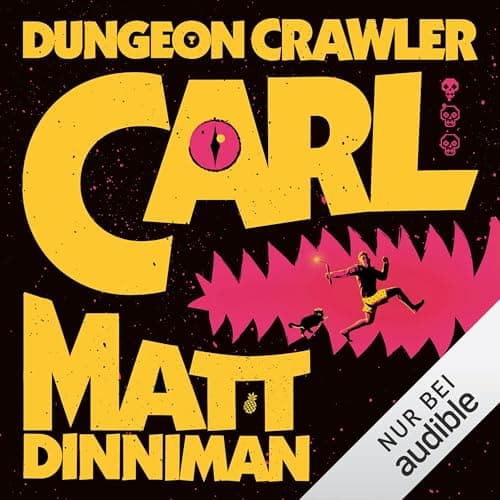

Everyone told me this series would be the funniest thing I'd ever listen to. Internet hype machine cranked to eleven, Reddit threads overflowing with devotion. So I went in expecting comedy gold and came out with something way more interesting — a German-language adaptation that made me rethink how localization changes the emotional texture of a story.
I was up late in my apartment, rain tapping against the windows in Capitol Hill, syncing caption files for a client project that had gone sideways. Needed something to reset my brain. Fired up Dungeon Crawler Carl in German — partly because I'm always hunting for non-English audiobook productions to evaluate for accessibility consulting, partly because I was genuinely curious how Stefan Kaminski would handle material that lives and dies on comedic timing and tonal shifts.
Kaminski's Carl Is Gruffer Than You'd Expect
Here's what surprised me: Kaminski plays Carl with this low, almost weary gruffness that hits different from what I've heard of the English version's vibe. There's a heaviness to his delivery that actually grounds the absurdity. When Carl's standing in his boxers and leather jacket watching the world literally collapse into dungeon floors, Kaminski doesn't go for laughs first — he goes for exhaustion. Bewilderment. And then the dark humor lands harder because of that setup.
The voice processing for the system AI notifications — those little digital pings and slightly modulated announcements — actually helped me as a hard-of-hearing listener. They create a sonic signature I could track even when my hearing aids were struggling with ambient noise. Small audio design choice, but accessibility done right, whether they intended it or not. The chat dings that simulate the alien audience watching the dungeon show? Those registered clearly every time, giving me spatial cues about the meta-narrative layer even during louder action sequences.
But here's where I got stuck: Princess Donut. The cat is supposed to be this scene-stealing personality, and Kaminski gives her a distinct enough voice, but the emotional range felt compressed. Donut's whole thing is performative ego masking genuine survival instinct, and I wanted more dynamic contrast between her showbiz persona and the moments of actual fear. Missed opportunity for tone shift here — the character practically begs for it.
The Baby Goblins Scene and What German Does to Dark Comedy
The infamous baby goblins scene. In English, from what I've gathered, it plays as shock comedy. In German, Kaminski leans into the visceral horror of it just a beat longer before the absurdity kicks in. German syntax naturally delays punchlines — the verb-final structure in subordinate clauses means you're sitting in tension a fraction longer. And Kaminski uses that. He doesn't rush through the grotesque setup to get to the joke. He lets it breathe.
As a hard-of-hearing listener this hit different. I rely heavily on pacing and rhythm to catch emotional cues, and that extra beat of tension before comedic release? It gave me time to process the tonal shift rather than scrambling to catch up. Clarity over speed — always. And Kaminski seems to instinctively understand that.
The LitRPG stat notifications and level-up announcements — always tricky in audio format — are handled with enough vocal differentiation that I could distinguish them from dialogue without visual confirmation. Not perfect, but functional. I'd love to see the publisher release a companion caption track, because the layered information (stats, dialogue, system messages, alien audience reactions) is genuinely a lot to parse through audio alone.
The Bro-Humor Question
Look, some listeners call this juvenile. And yeah, there are moments where the humor skews edgy in a way that made me wince — not because I'm above it, but because the book is clearly capable of more sophisticated comedy and sometimes settles for easy laughs instead. The drug-dealing llamas bit is funny once. The underlying satire about media exploitation and reality TV culture? That's the real engine here, and it's sharp enough to cut when Dinniman lets it.
Kaminski's occasionally callous tone actually works for me in the context of a protagonist who's performing detachment as a coping mechanism. Carl isn't genuinely indifferent to the horror around him — he's dissociating. And Kaminski's flat delivery in certain violent scenes reads (to me, at least) as trauma response rather than carelessness. Whether that was intentional is another question.
Who Gets the Credit, Who Keeps Walking
If you're a LitRPG fan curious about how German narration handles the subgenre's particular quirks — the stat dumps, the system notifications, the genre-aware humor — this is a genuinely interesting case study. If you need tight caption sync or accessibility features beyond the base audio, you're going to be frustrated. The production has smart touches but stops short of full accessibility integration.
Pick this up if you want a German performance that prioritizes gritty tone over pure comedy. Skip it if juvenile humor is a dealbreaker — the sophistication is there but inconsistent, and no narrator can fix material they don't have.
The Emotional Layers Come Through Even Without Sound
I ended up finishing this at 2 AM, caption files forgotten, rain still going. Kaminski didn't make me laugh as much as I expected. He made me feel the exhaustion of a guy trapped in an impossible system, performing for an audience that wants him dead. The performance is layered enough to feel. That counts for something — maybe for a lot. Tolkien understood that same principle — that exhaustion and impossible stakes, rendered with enough texture, land harder than any joke — and the narration in Fellowship of the Ring carries that same bone-deep weight of a protagonist performing endurance for an audience that may not deserve it.









