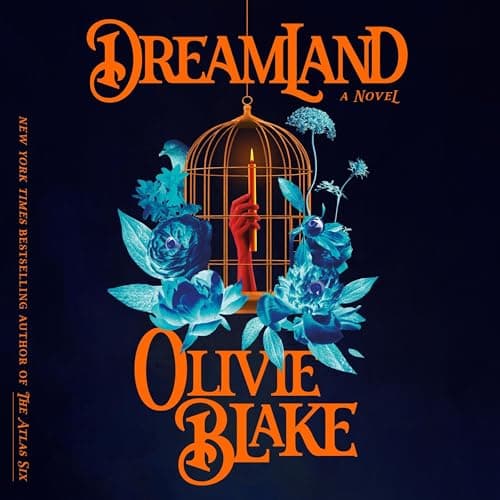
So here's the thing - everyone kept telling me Olivie Blake was a genius, that The Atlas Six was genre-bending brilliance, and that Dreamland would be her gothic LA masterwork. I went in expecting to be floored. I came out feeling like I'd been handed a beautiful cocktail that was mostly ice.
Let me set the scene. It's 4:15 AM, the unit is weirdly calm (I knocked on the break room table, don't worry), and I'm charting on a patient who's finally stable after a rough night. I've got one earbud in, the other ear open for alarms, and Dreamland is whispering this moody, heat-soaked LA atmosphere into my brain. The Santa Ana winds, the villa in the Hollywood hills, the "summer of exsanguination" with girls turning up dead - it genuinely matched the eerie stillness of a trauma center between codes. The vibes were immaculate. The vibes were doing a LOT of heavy lifting.
The Villa Looks Gorgeous But Nobody Turns the Lights On
Anya Morris is a Filipina-American aspiring actress living at home, working at the family store, dealing with her mother's disappointment about her career choices. And listen - I felt that in my bones. Eldest daughter of immigrants, chasing a dream that doesn't fit the family plan? My mom's face flashed before my eyes. My mom would love this (she still thinks I should've been a doctor). But here's where I got frustrated: Anya's characterization starts strong and then just... floats. She enters the de Witt family orbit, meets the mysterious reclusive Jude, and from there she becomes more of a vessel for the atmosphere than an actual person making choices. She drifts into danger the way someone drifts into a pool - slowly, passively, while the reader is on the deck yelling "GIRL, THE WATER IS RED."
The occult family curse angle, the Hollywood dynasty rot, the blood-soaked history of the villa - Blake sets up so many fascinating threads. But they tangle instead of weave. By the midpoint I kept waiting for the story to grab me by the throat, and instead it just kept stroking my hair. Which, fine, some people want that. But the book promises horror and seduction and power, and what it mostly delivers is mood. Gorgeous, suffocating, relentless mood.
Seven Narrators Walk Into a Villa
Seven narrators. Including the author herself. That's ambitious for a 9-hour-45-minute book, and honestly? It's a mixed result. Steve West brings a nice gravity to the male POV sections - he's got this low, controlled energy that works for Jude's unsettling presence. The female narrators handle Anya's sections competently, but with this many voices rotating through a story that's already structurally unconventional, there were moments where I lost track of whose perspective I was in. Not because the voices sound alike, but because the writing itself doesn't always clearly signal the shift.
Olivie Blake narrating her own sections is an interesting choice. There's an intimacy to hearing the author read their own words, but it also highlights when the prose gets a little too in love with itself. Some passages feel like they were written to be read aloud at a candlelit event - which isn't a criticism of the performance, exactly, but of the pacing. At 3x the density and half the forward momentum, certain chapters made my eyelids heavy even on a night shift. And I was AWAKE.
When the Blood Hits Different
The violence and the sexual content are there, as promised, and Blake doesn't flinch from either. But here's my issue as someone who has actually seen what exsanguination looks like - the horror elements feel more aesthetic than visceral. The murders are backdrop. The curse is atmosphere. Even Jude's danger reads as romantic shorthand rather than genuine threat for most of the book. I wanted to feel afraid FOR Anya, and instead I just felt vaguely concerned, like watching someone text while crossing the street.
That said - there's a sequence in the back third involving the villa's history that genuinely unsettled me. Blake's writing about generational violence and the cost of legacy hits harder than the supernatural elements. That's where the book earned my attention back.
Who Gets an Invitation (And Who Gets Turned Away at the Gate)
If you loved the vibes of Mexican Gothic but wished it was set in Hollywood, this is your book. We Have Always Been Here scratched a similar itch for me — that same slow-burn dread wrapped in lush atmosphere, where you're never quite sure if the horror is external or just the weight of being in a place that doesn't want you there. If you need your horror to actually scare you and your plot to actually move, you're going to be checking the progress bar a lot. Skip this one if you want tight pacing or clear payoffs - it'll just frustrate you. I'm somewhere in the middle - I appreciated what Blake was building, but I kept wanting more foundation under all that gorgeous architecture.
Carlos asked why I looked annoyed when I got home. I told him I'd been arguing with a book that was almost great. He said that's how I describe most of my shifts too. He's not wrong.
Night Shift Discharge Notes
Dreamland is a 7-out-of-10 atmosphere trapped in a 5-out-of-10 plot. The writing is lush, the LA setting crackles with heat and menace, and the cultural details around Anya's family feel genuine and specific. But the story never fully commits to being the thriller it promises or the literary horror it could be. It's caught between genres the way Anya is caught between worlds, and unlike Anya, it never quite makes its choice. Perfect for that post-shift decompression if you want something moody and don't need resolution to feel satisfied.









