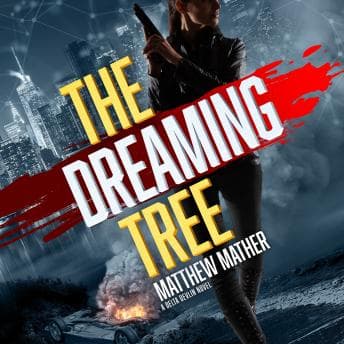

Everyone's calling this "Shutter Island meets Jacob's Ladder" and I get it - I do - but that comparison undersells what Mather's actually doing here. Those films are about unreliable reality. The Dreaming Tree is about unreliable bodies. About waking up in flesh that isn't yours and wondering if the nightmares bleeding into your waking hours belong to you or to the dead man whose nervous system you're now piloting.
I listened to this at 2 AM because I couldn't sleep anyway. Shirley (my cat) was unimpressed. I was terrified. But not in the way I expected.
The Body Horror We Don't Talk About Enough
Horror loves body horror - the grotesque, the visceral, the Cronenbergian. But Mather goes somewhere weirder. Royce's full-body transplant isn't played for gore. It's played for existential dread. Who are you when your hands aren't your hands? When your reflexes belong to someone else? When you answer the door and a detective with mutated eyes looks at you like she can see the ghost still living in your borrowed skin?
Tom Taylorson gets this. His performance as Royce isn't just good voice acting - it's a clinic in conveying dissociation. The confusion. The fear. The moments where Royce's internal monologue spirals into something that feels genuinely unhinged. I heard that same unraveling in Other Mrs., though that book leans more into paranoia than existential dread. Taylorson doesn't just read the words; he sounds like a man coming apart at the seams while desperately trying to hold it together. By hour three, I'd stopped thinking of it as a performance. It just was Royce.
Delta Devlin Deserves Her Own Series
Robin Eller handles Detective Devlin, and here's where the dual-narrator structure earns its keep. Devlin's chapters have a different energy entirely - sharper, more controlled, with an accent that gives her this working-class New York edge that contrasts beautifully with Royce's increasingly fractured perspective. She sees things nobody else can. Visions. And Eller plays her as someone who's learned to weaponize her "mutation" while never quite trusting it.
The interplay between narrators mirrors the interplay between characters. Royce is spiraling. Devlin is hunting. And somewhere in the black-market underworld of billionaires buying immortality through stolen bodies, their stories collide in ways I genuinely didn't see coming. That same sense of dark conspiracy threading through seemingly unconnected lives shows up in Ceremony in Death, though that one trades body horror for occult rituals.
Where It Gets Messy (And Not Always In A Good Way)
Look. I need to be honest. The first stretch of this audiobook is work. Mather's setting up a lot - the body transplant procedure, Royce's fragmented memories, Devlin's investigation, the hallucinogenic episodes that may or may not be real. It's dense. Some listeners have bounced off it entirely, and I understand why. The narrative doesn't hold your hand.
And the last few chapters? The structure gets... ambitious. Bouncing between perspectives, timelines, revelations. The ending hits hard - there's a twist that genuinely surprised me, and I've been consuming horror for two decades - but getting there requires patience with some narrative whiplash.
The Dreaming Tree understands that horror isn't about gore - it's about dread. But it also asks a lot of its audience.
Who Needs This In Their Ears (And Who Should Run)
If you're tired of horror that relies on jump scares and cheap thrills, if you want something that crawls under your skin through ideas rather than violence, if you've ever wondered what Philip K. Dick would write if he were obsessed with the black market organ trade - this is your book.
Skip if: you need linear storytelling, you're listening casually while doing other things (this demands focus), or psychological horror isn't your thing. If you scare easily, this one's not for you either.
Signing Off From The Witching Hour
My podcast listeners are going to love this. It's the kind of horror that generates conversation - about identity, about consciousness, about what we'd sacrifice for immortality. The dual narration elevates material that could've felt clinical in lesser hands. Taylorson and Eller don't just read this book; they inhabit it.
Is it perfect? No. That rocky opening act and the occasionally disorienting final stretch keep it from true greatness. But when it works - and it works more often than it doesn't - The Dreaming Tree is exactly the kind of cerebral, unsettling, beautifully performed horror that reminds me why I do what I do.
Finally, horror that respects the genre.