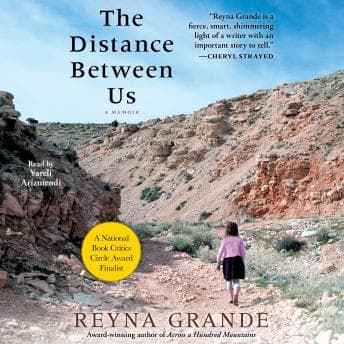

I was three hours into a logo redesign for a mezcal brand — the kind of project where you're staring at kerning until your eyes blur — when Reyna Grande described hiding under a table while her grandmother raged about having too many mouths to feed. I stopped working. Just sat there with my stylus hovering over the tablet while Frida headbutted my elbow, because suddenly I was back in my abuela's kitchen in San Antonio, listening to stories about what her family left behind when they crossed. Different details, different decade, same ache in the chest.
This book felt like someone took every whispered story I half-understood as a kid and wrote them down with the kind of honesty that makes your throat close up.
The Girl Who Kept Getting Left Behind
Reyna Grande was four when her father left for "El Otro Lado." Then her mother followed. And what hits hardest isn't the border crossing itself — though that comes later, and it's harrowing — it's the years of waiting. The way young Reyna builds her absent father into this mythic figure, this savior who's going to come back and fix everything, while she's stuck in Iguala with a grandmother who resents her and siblings who are just as lost. Grande writes about childhood hunger not as a political statement but as a physical, daily humiliation. She talks about her belly swelling, about eating sugar water, about the shame of showing up to school without shoes. It's specific in a way that doesn't let you look away.
And then — the gut punch — when she finally gets to the U.S. and meets her father, he's not the hero she imagined. He's an alcoholic. He's controlling. He hits. The distance between them isn't just geographic anymore; it's the gap between the father she needed and the man he actually is. Where She Went sits in that same wreckage — the space between who someone was to you and who they turn out to be — and it wrecked me in a comparable way, though from a very different angle. Grande captures that particular devastation of a child realizing their parent is just a broken person, and she does it without melodrama, which somehow makes it worse.
Yareli Arizmendi Carries This Like Prayer
I went in not knowing Arizmendi's work, and I came out wanting to listen to everything she's ever narrated. Her voice has this quality — warm but restrained, like she's telling you something painful in a kitchen at midnight and trying not to wake the house. She doesn't oversell the emotional moments, which is exactly right for a memoir this raw. When Grande describes her mother leaving the second time, Arizmendi's delivery gets quieter, not louder, and that quiet is what broke me.
Compared to something like Jeanette Walls narrating her own "Glass Castle," Arizmendi brings a different kind of intimacy — she's not the author, but she sounds like she could be a tía who lived next door and watched it all happen. There's a naturalness to her Spanish pronunciation that matters here, because this is a book that lives between two languages, and having a narrator who moves between them without making it feel like a performance? That's everything.
I do wish I had more to say about specific vocal choices for different characters — the research didn't give me much to work with on that front, and honestly, by hour six I was so deep in the emotional current that I stopped analyzing technique. That's either a flaw in my reviewing or the highest compliment I can give. Probably both.
The Part Where I Called My Mom at 11 PM
There's a section where Reyna talks about her mother's return to Mexico — defeated, changed, smaller somehow — and the children don't know how to be around her anymore. They've been abandoned and reclaimed so many times that love starts to feel like a trick. I ugly-cried at that part. Not the pretty kind. The kind where Diego jumps off my lap because I'm shaking.
And then I called my mom. Because my family's story isn't Reyna's story, but there are echoes — the sacrifices that look like abandonments from a child's height, the way immigration reshapes families into shapes they don't recognize. My mom picked up and said "mija, it's late" and I just said "I know, I just wanted to hear your voice." She didn't ask why. She already knew.
Abuela would have loved this one. She would've sat through every minute, rosary in hand, nodding at parts that hit close. She would've said "así es" — that's how it is — which was her way of saying a story told the truth.
Who This Is For (and Who Should Brace Themselves)
If you grew up in a family shaped by immigration — documented, undocumented, anywhere on that spectrum — this book is going to reach into your chest. If you didn't, it's one of the most accessible, human ways to understand what that experience actually feels like from the inside, not as policy debate but as a child's reality.
Skip it if you need a neat resolution. Grande doesn't tie bows. Her father doesn't get a redemption arc. Her family doesn't magically heal. That's what makes it real.
At 11 hours and 36 minutes, it's a commitment, but at 1.0x speed (the only speed, fight me), the pacing earns every minute. Some memoirs pad their middle sections — this one just keeps peeling back layers until you're sitting with the raw thing underneath.
My Heart Needed This, Even When It Hurt
Five crying sessions. New personal record. I'm adding a column to the spreadsheet.