
Six hours of my life I could've spent on three client calls. Was it worth it?
Honestly? Mostly yes. But with significant caveats.
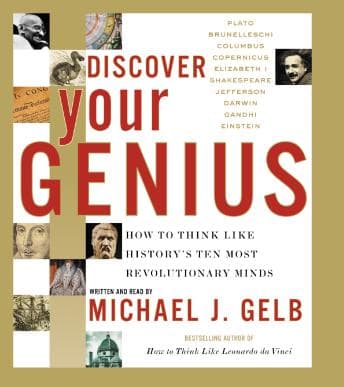
I finished this one during a red-eye to Chicago, couldn't sleep anyway, figured I'd multitask my insomnia into professional development. Gelb's premise is solid: study ten historical geniuses, extract their core operating principles, apply them to your own life. It's the kind of framework consultants love because it's modular, memorable, and makes for great PowerPoint slides.
The McKinsey Partner Would Approve (Mostly)
Here's what works: Gelb genuinely knows his material. The man has spent decades studying creative thinking, and his enthusiasm bleeds through the narration. When he gets into Einstein's "combinatory play"—essentially the idea that genius comes from connecting unrelated concepts—you can hear him getting excited. That energy is infectious. Same with the Brunelleschi section on perspective. The architect who figured out linear perspective and then built the Florence Cathedral dome? That's a legitimate case study in vision plus execution. That same infectious energy shows up in Outliers, where Gladwell's enthusiasm for pattern-finding makes even dry statistics feel revelatory.
The practical exercises are actually useful. Not the fluffy "journal about your feelings" stuff that plagues most self-help. Real prompts that force you to think differently. I've already adapted two of them for a workshop I'm running next month.
Where My Parents Would've Walked Out
But here's the thing—and this is where I get harsh (Jenny would say predictably so): the biographical sketches are surface-level. If you've read any serious history, you'll find yourself ahead of the material. I kept waiting for deeper insight and getting Wikipedia-plus.
And look, we need to talk about the Columbus inclusion. I get it—the man had vision and persistence. But positioning him as a genius archetype in 2024 without meaningfully engaging with the, uh, genocide thing? That's a choice. My parents, who actually experienced colonialism's aftermath in Korea, would have some thoughts. Strong ones.
The Elizabeth I section is better—there's genuine insight about wielding power with restraint, knowing when to act and when to wait. That's applicable. That's the kind of historical wisdom that translates to modern leadership. More of that, less hagiography.
The Author-Narrated Gamble
Gelb narrates his own work, which is always a risk. Here it pays off about 75% of the time. His enthusiasm adds something you wouldn't get from a professional narrator—he clearly believes in this material. But he's not a voice actor. The energy stays at one level throughout, which at hour four starts to feel like being trapped in a very earnest TED talk that won't end.
I bumped it to 1.5x speed (my usual 2.0x felt disrespectful to the material) and that helped. The pacing is designed for note-taking, which means it drags if you're just absorbing passively.
The ROI Calculation
Bottom line: This is a solid framework book disguised as historical biography. If you go in expecting deep historical scholarship, you'll be disappointed. If you go in looking for actionable mental models with historical context, you'll get value.
The key takeaway is worth the listen. The other 4 hours of biographical padding? Less essential. Skip to the exercises and principles if you're short on time.
I've already used the Darwin section on observation in a client presentation. That's the test, right? Can you actually apply it? For about 60% of this book, yes. Gambler has a better signal-to-noise ratio—Puzo's life lessons hit harder because they're earned through actual risk, not historical distance. The rest is filler dressed up as context.
My parents built a successful business without reading a single self-help book. They just worked. But I think they would've appreciated the Gandhi section on aligning spirit, mind, and body—that's essentially what they did instinctively. Now it has a framework.
Who Gets Value Here
Listen if: You want actionable creativity frameworks and don't mind some historical hand-waving to get there. Consultants, workshop facilitators, anyone who needs to sound smart about innovation.
Skip if: You're a history buff who'll get annoyed by surface-level biography, or you need your self-help without the problematic Columbus detour.
Worth a credit if you're into this genre. Worth a library hold if you're skeptical. Either way, bring a notebook.









