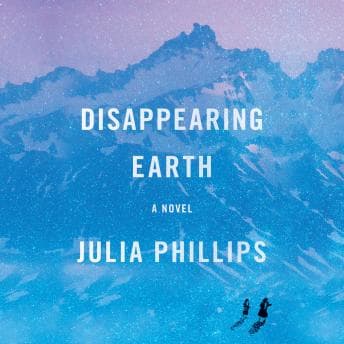

What happens to a community when its children vanish and no one is ever held accountable?
I was up at 2 AM finishing this one, Frida curled against my feet and Diego judging me from across the room like he knew I was about to be emotionally wrecked. And I was. But not in the way I expected.
Disappearing Earth opens with a gut-punch: two sisters, Alyona and Sophia, eight and eleven years old, disappear from a beach on Russia's Kamchatka peninsula. A stranger's van. A mother's worst nightmare crystallized into eleven hours of audio. But here's the thing—Julia Phillips doesn't give you a thriller. She gives you something harder. Something that crawls under your skin and stays there.
Twelve Women, One Wound That Won't Close
Each chapter follows a different woman in this remote, volcanic region. A month passes between each one. And every single woman is connected to the disappearance—some obviously, some in ways that only reveal themselves slowly, like bruises surfacing days after a fall.
There's the detective's wife, wrestling with her husband's obsession with the case. There's a young woman whose own trauma mirrors the missing girls in ways the community refuses to acknowledge. There's an Indigenous Even woman whose daughter went missing years ago, and nobody cared because she wasn't the right kind of victim.
Phillips is doing something brutal here. She's showing us how tragedy doesn't unite a community—it exposes every crack that was already there. The ethnic tensions between Russians and Indigenous peoples. The way some missing girls get media coverage and search parties while others just... disappear into silence. My abuela would have recognized this. The way certain people are deemed worthy of grief and others aren't.
I ugly-cried at chapter nine. The one with Ksyusha, the young woman who survived something terrible and watches the whole town rally for these two white Russian girls while her own assault was swept under the rug. The vibes are immaculate—and by immaculate I mean devastating in the most precise, surgical way possible.
Ilyana Kadushin and the Geography of Grief
Okay, so the narration. Ilyana Kadushin's Russian pronunciation is the real deal—names like Valentina Nikolaevna and places like Petropavlovsk-Kamchatsky roll off her tongue with an authenticity that grounds you in this specific, isolated corner of the world. You feel the remoteness. The way the Pacific crashes against volcanic shores. The tundra stretching endlessly.
But—and this is important—the structure of this book is challenging in audio format. Each chapter introduces a new woman, a new voice, a new perspective. By the time you've settled into one life, you're yanked into another. I found myself rewinding more than usual, especially in the middle sections where the connections between characters are subtle. Some listeners have said they needed the print version alongside to track everyone, and honestly? I get it. This is not a background listen. This is a "pause your design work and actually pay attention" listen.
Kadushin handles the emotional weight beautifully—there's a quietness to her delivery that suits the book's melancholy. But I wished for slightly more differentiation between the women's voices. When you're jumping between twelve perspectives, a little more vocal distinction would help anchor you.
A Slow Burn That Doesn't Burn the Way You Want
Here's where I have to be honest: the ending. After eleven hours of building this web of women and loss and systemic injustice, the resolution felt... unfinished. Not in a literary, ambiguous way that I could respect. More like the book just stopped.
I sat in silence for a full minute after it ended, waiting for more. Frida meowed at me like "you okay?" and I genuinely wasn't sure.
Some readers will love this. The point isn't solving the mystery—it's witnessing how trauma ripples outward, how a community metabolizes (or fails to metabolize) violence against its most vulnerable. But if you're coming to this expecting thriller payoff, you'll be frustrated. This is a rainy Sunday book, the kind that leaves you staring out the window afterward, thinking about all the girls who disappeared without anyone writing novels about them.
Who Will Cry With Me (And Who Should Walk Away)
Grab this if you love character-driven literary fiction that prioritizes emotional truth over plot mechanics. If you appreciated My Year of Rest and Relaxation or The Tiger's Wife, you'll find something here. Finding the Dream has that same literary weight—women navigating impossible choices in landscapes that feel like characters themselves. If you're fascinated by remote landscapes and the way geography shapes community, Kamchatka will haunt you.
Skip this if you need resolution. If mystery is your genre and you want answers, this will make you throw your headphones. Also skip if you struggle with multiple POVs in audio—the constant perspective shifts are genuinely disorienting without visual chapter markers.
My Heart, Still Somewhere on That Volcanic Shore
This book felt like standing at the edge of the world, looking out at cold water, knowing something terrible happened here and no one will ever be punished for it. Phillips writes women's fear and resilience and quiet rage with a precision that made me ache. The way mothers in this book hold their children tighter. The way some women run toward danger to save others. The way the Indigenous characters' grief is treated as less urgent, less real.
Abuela would have cried at this one too. She would have understood every woman in it—the ones who fight, the ones who freeze, the ones who look away because looking hurts too much.
Not a perfect audiobook experience. But a book that mattered. And sometimes that's enough.